When AI becomes an intellectual intermediary: A situated correspondence framework linking epistemic responsibility, intellectual engagement, and independent capability in higher education
DOI:
https://doi.org/10.32351/rca.v11.443
Keywords:
generative artificial intelligence, higher education, epistemic responsibility, intellectual engagement, assessment validity, human agency, cognitive offloadingAbstract
Generative artificial intelligence has unsettled a familiar educational inference: that the quality of an academic product is adequate evidence of the intellectual work performed by the student who submits it. This conceptual article develops the Situated Correspondence Framework, an analytical architecture that connects three moments often treated separately: the intellectual operations a task assigns to the learner, evidence that those operations were enacted during AI-mediated activity, and the capabilities that remain demonstrable when assistance conditions change. The framework distinguishes Assigned Epistemic Responsibility (AER) and Constitutive Intellectual Operations (CIO) from Enacted Intellectual Engagement (EIE), AI-Assisted Performance (AIP), and Demonstrated Independent Capability (DIC), while treating AI Assistance Configuration (AIC) and Situated Opportunity Conditions (SOC) as proximal interpretive conditions rather than learner attributes. Drawing on research on cognitive offloading, human–technology partnership, evaluative judgement, assessment validity, AI literacy, and educational capability, six propositions are formulated for empirical challenge. The contribution is not a new label for offloading, engagement, or independent performance. It lies in linking ex ante intellectual responsibility to observed enactment and later demonstrability without assuming that assisted performance and learner capability coincide. This evidentiary layer extends a broader human-centered learning agenda while leaving open a question that cannot be settled in the abstract: which operations should remain attributable to the learner across different disciplines and assessment purposes?
Downloads
References
Almazrou, S., Alanezi, F., Almutairi, S. A., AboAlsamh, H. M., Alsedrah, I. T., Arif, W. M., Alsadhan, A. A., AlSanad, D. S., Alqahtani, N. S., AlShammary, M. H., Bakhshwain, A. M., Almuhanna, A. F., Almulhem, M., Alnaim, N., Albelali, S., & Attar, R. W. (2025). Enhancing medical students critical thinking skills through ChatGPT: An empirical study with medical students. Nutrition and Health, 31(3), 1023–1033. https://doi.org/10.1177/02601060241273627
Bearman, M., Tai, J., Dawson, P., Boud, D., & Ajjawi, R. (2024). Developing evaluative judgement for a time of generative artificial intelligence. Assessment & Evaluation in Higher Education, 49(6), 893–905. https://doi.org/10.1080/02602938.2024.2335321
Bencsik, A., Jenei, S., & Módos-Szalai, S. (2026). Who gets to use ChatGPT? A global study on digital access and inequality in higher education. Social Sciences & Humanities Open, 13, 102479. https://doi.org/10.1016/j.ssaho.2026.102479
de Carvalho, M. R., Greco, M. E., & de Souza, D. M. (2025). Use of ChatGPT as a study and teaching complementary tool in the medical course. Educação e Pesquisa, 51, e288875. https://doi.org/10.1590/S1678-4634202551288875en
Chen, X. (2026). Layer-sensitive cognitive offloading in generative AI-assisted writing: Supported performance and independent no-AI outcomes. Frontiers in Psychology, 17, 1906199. https://doi.org/10.3389/fpsyg.2026.1906199
Chi, M. T. H., & Wylie, R. (2014). The ICAP framework: Linking cognitive engagement to active learning outcomes. Educational Psychologist, 49(4), 219–243. https://doi.org/10.1080/00461520.2014.965823
Dawson, P., Bearman, M., Dollinger, M., & Boud, D. (2024). Validity matters more than cheating. Assessment & Evaluation in Higher Education, 49(7), 1005–1016. https://doi.org/10.1080/02602938.2024.2386662
Du, Y., & Yuan, Y. (2026). Epistemic dependence in AI-mediated learning within higher education: A framework for student judgement and responsibility. Assessment & Evaluation in Higher Education. Advance online publication. https://doi.org/10.1080/02602938.2026.2732250
Ebrahimzadeh, M., Shibani, A., & Buckingham Shum, S. (2026). Coauthorship integrity: Reconceptualising assessment validity for the age of generative artificial intelligence. Computers and Education: Artificial Intelligence, 10, 100609. https://doi.org/10.1016/j.caeai.2026.100609
Fredricks, J. A., Blumenfeld, P. C., & Paris, A. H. (2004). School engagement: Potential of the concept, state of the evidence. Review of Educational Research, 74(1), 59–109. https://doi.org/10.3102/00346543074001059
Gao, L., & Zhang, F. (2026). Cognitive offloading and metacognitive calibration in generative AI-mediated doctoral learning: A grounded theory study of accountable reconstruction. Frontiers in Psychology, 17, 1920947. https://doi.org/10.3389/fpsyg.2026.1920947
Hornberger, M., Bewersdorff, A., Schiff, D. S., & Nerdel, C. (2025). A multinational assessment of AI literacy among university students in Germany, the UK, and the US. Computers in Human Behavior: Artificial Humans, 4, 100132. https://doi.org/10.1016/j.chbah.2025.100132
Jaakkola, E. (2020). Designing conceptual articles: Four approaches. AMS Review, 10, 18–26. https://doi.org/10.1007/s13162-020-00161-0
Kawai, R., Ito, T., & Itabashi, S. (2025). Developing critical thinking attitudes in university students using ChatGPT. Journal of the Japan Society of Technology Education, 67(1), 51–58. https://doi.org/10.32309/jjste.67.1_51
Lan, M., & Zhou, X. (2025). A qualitative systematic review on AI empowered self-regulated learning in higher education. npj Science of Learning, 10, 21. https://doi.org/10.1038/s41539-025-00319-0
Long, D., & Magerko, B. (2020). What is AI literacy? Competencies and design considerations. In Proceedings of the 2020 CHI Conference on Human Factors in Computing Systems (pp. 1–16). Association for Computing Machinery. https://doi.org/10.1145/3313831.3376727
López Ayala, M. G. (2026). Spectra Human-Centered Learning Framework: A Socio-Technical Architecture for AI-Supported Higher Education. MenteClara Foundation’s Peer-Reviewed Journal, 11, 441. https://doi.org/10.32351/rca.v11.441
Luo, J., & Yin, X. (2026). Tracing student engagement in dialogues with GenAI in assessment: A semester-long exploratory study. Innovations in Education and Teaching International. Advance online publication. https://doi.org/10.1080/14703297.2026.2663354
Masalimova, A. R., Zheltukhina, M. R., Demir, S., Molodozhnikova, N. M., Zvereva, E. V., Berechikidze, I. A., & Lazareva, Y. B. (2026). Mapping human–AI communication in a Russian higher education context: A psychometric network analysis of AI literacy and attitudinal dispositions. Frontiers in Communication, 11, 1888712. https://doi.org/10.3389/fcomm.2026.1888712
Oliveira, M., Zednik, C., Bombaerts, G., Sadowski, B., & Conijn, R. (2025). Assessing students' DRIVE: A framework to evaluate learning through interactions with generative AI. Computers and Education: Artificial Intelligence, 9, 100497. https://doi.org/10.1016/j.caeai.2025.100497
Panadero, E. (2017). A review of self-regulated learning: Six models and four directions for research. Frontiers in Psychology, 8, 422. https://doi.org/10.3389/fpsyg.2017.00422
Risko, E. F., & Gilbert, S. J. (2016). Cognitive offloading. Trends in Cognitive Sciences, 20(9), 676–688. https://doi.org/10.1016/j.tics.2016.07.002
Saito, T. (2026). Redefining agency: A capability-driven research agenda for generative AI in education. Education Sciences, 16(1), 155. https://doi.org/10.3390/educsci16010155
Salomon, G., Perkins, D. N., & Globerson, T. (1991). Partners in cognition: Extending human intelligence with intelligent technologies. Educational Researcher, 20(3), 2–9. https://doi.org/10.3102/0013189X020003002
Schraw, G., & Dennison, R. S. (1994). Assessing metacognitive awareness. Contemporary Educational Psychology, 19(4), 460–475. https://doi.org/10.1006/ceps.1994.1033
Sharma, S. (2026). Educational integrity in GenAI-augmented assessment: Making judgement visible. International Journal for Educational Integrity, 22, 6. https://doi.org/10.1007/s40979-026-00216-y
Snyder, H. (2019). Literature review as a research methodology: An overview and guidelines. Journal of Business Research, 104, 333–339. https://doi.org/10.1016/j.jbusres.2019.07.039
Soderstrom, N. C., & Bjork, R. A. (2015). Learning versus performance: An integrative review. Perspectives on Psychological Science, 10(2), 176–199. https://doi.org/10.1177/1745691615569000
Tai, J., Ajjawi, R., Boud, D., Dawson, P., & Panadero, E. (2018). Developing evaluative judgement: Enabling students to make decisions about the quality of work. Higher Education, 76, 467–481. https://doi.org/10.1007/s10734-017-0220-3
Velázquez-García, L., Cedillo-Hernández, A., Colón-Vallejo, A., & Longar-Blanco, M. del P. (2025). Examining the impact of ChatGPT on Mexican students' performance in higher education. International Journal of Information and Education Technology, 15(7), 1368–1376. https://doi.org/10.18178/ijiet.2025.15.7.2338
Walker, M. (2008). A human capabilities framework for evaluating student learning. Teaching in Higher Education, 13(4), 477–487. https://doi.org/10.1080/13562510802169764
Walton, J., Bearman, M., Crawford, N., Tai, J., & Boud, D. (2026). How university students work on assessment tasks with generative artificial intelligence: Matters of judgement. Assessment & Evaluation in Higher Education, 51(6), 1066–1082. https://doi.org/10.1080/02602938.2025.2570328
Weidlich, J. (2026). Which inference is at risk? Assessment validity reasoning and generative AI. Assessment & Evaluation in Higher Education. Advance online publication. https://doi.org/10.1080/02602938.2026.2734795
Wong, S. S. H., & Qiu, S. X. (2026). Think first, ChatGPT later: Guiding human–AI collaboration for learning gains in independent human creativity. Educational Psychology Review, 38, 45. https://doi.org/10.1007/s10648-026-10118-7
Zhu, Q., Li, X., Dong, Y., Chang, P., & Fan, M. (2026). Not all cognitive offloading is equal: Distinguishing dependent and autonomous offloading to generative AI. Frontiers in Psychology, 17, 1878629. https://doi.org/10.3389/fpsyg.2026.1878629
Estadísticas de lectura: 93
Descargas: PDF 40 - HTML 9 - XML 5 - EPUB 5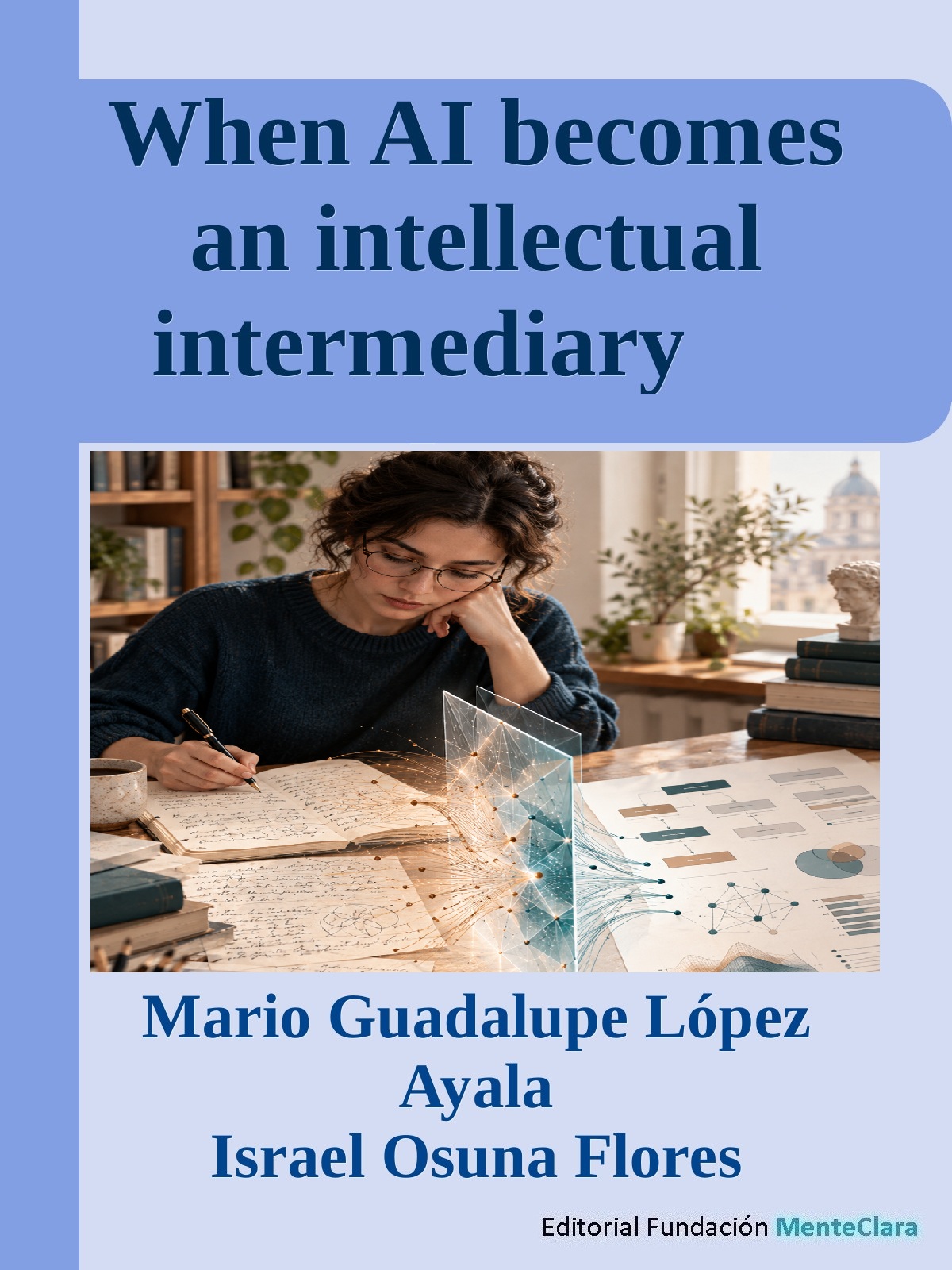
Published
Issue
Section
License
Copyright (c) 2026 MenteClara Foundation’s Peer-reviewed Journal

This work is licensed under a Creative Commons Attribution 4.0 International License.
Authors who publish in this journal agree with the following terms:
a. Authors publish under a Creative Commons Acknowledgment 4.0 International license that allows others to share the work with an authorship acknowledgment of the work and the initial publication in this journal.
b. Authors, who retain their rights after publication, are allowed and encouraged to disseminate their work electronically (for example, in institutional repositories or on their own website) before and during the submission process, as it may result in productive exchanges as well as earlier and greater citations of published works (See The Effect of Open Access).
 Since November 1st, 2018, all articles published in this journal are available under a Creative Commons Acknowledgment 4.0 International license.
How to Cite





 View the