UNEMPLOYMENT IS NOT A PROBLEM TO BE SOLVED: IT IS THE PATH WE ARE ON
From Necessary Labor to Leisure: Slavery, Mechanization, Artificial Intelligence, and the Possibility of a Post-Employment Citizenship
DOI:
https://doi.org/10.32351/rca.v11.437
Keywords:
work, unemployment, artificial intelligence, automation, productivity, leisure, citizenship, universal basic income, Inequality, attention economyAbstract
The relationship between work, productivity, and leisure has undergone profound transformations throughout history. In the slave societies of Antiquity, certain forms of social organization allowed segments of the population to devote time to political, cultural, religious, and recreational activities through the appropriation of the labor of other human beings. The Industrial Revolution introduced a qualitatively different transformation by enabling machines to progressively replace part of human labor. Today, artificial intelligence extends this process to cognitive and professional tasks. This article proposes an alternative interpretation of the so-called unemployment problem: when a society reaches levels of productivity that make it possible to produce goods and services with a decreasing amount of human labor, the reduction in employment should not necessarily be regarded as an economic failure, but potentially as a liberation of time. The central problem therefore shifts from the creation of jobs to the distribution of the benefits of productivity. The article examines the attention economy, the concentration of benefits derived from digitalization, the redistributive function of the State, and the possibility of partially decoupling material subsistence from employment. Drawing on historical and contemporary precedents, including Keynes's reflections on the future of work, experiences with Universal Basic Income, and current debates surrounding artificial intelligence, the article proposes the hypothesis that AI could enable the democratization of leisure historically reserved for minorities. The decisive question, therefore, would not be how to preserve employment indefinitely, but how to transform increasing productivity into leisure, material security, and citizenship.
Downloads
References
Alphabet Inc. (2025). 2024 annual report. https://abc.xyz/assets/99/21/46cafdba41089a12a2d86ea47d44/goog026-annualreport2024-web.pdf
Autor, D. H. (2024). Applying AI to rebuild middle class jobs. National Bureau of Economic Research Working Paper, 32140. https://doi.org/10.3386/w32140
Cazzaniga, M., Jaumotte, F., Li, L., Melina, G., Panton, A. J., Pizzinelli, C., Rockall, E. J., & Mendes Tavares, M. (2024). Gen-AI: Artificial intelligence and the future of work (IMF Staff Discussion Note 2024/001). International Monetary Fund. https://doi.org/10.5089/9798400262548.006
Cowen, T. (2018). Why hasn’t economic progress lowered work hours more? Social Philosophy and Policy, 35(2), 284–300. https://doi.org/10.1017/S0265052518000152
Forget, E. L. (2011). The town with no poverty: The health effects of a Canadian guaranteed annual income field experiment. Canadian Public Policy, 37(3), 283–305. https://doi.org/10.3138/cpp.37.3.283
Garlan, Y. (1988). Slavery in ancient Greece (J. Lloyd, Trans.; rev. and expanded ed.). Cornell University Press.
Garland, R. (2018). What is a slave society? The struggle for a forgotten concept. Cambridge University Press.
Gmyrek, P., Berg, J., & Bescond, D. (2023). Generative AI and jobs: A global analysis of potential effects on job quantity and quality (ILO Working Paper 96). International Labour Organization. https://doi.org/10.54394/FHEM8239
Hum, D., & Simpson, W. (2001). A guaranteed annual income? From Mincome to the millennium. Policy Options, 22(1), 78–82.
Kangas, O., Jauhiainen, S., Simanainen, M., & Ylikännö, M. (Eds.). (2021). Experimenting with unconditional basic income: Lessons from the Finnish basic income experiment 2017–2018. Edward Elgar Publishing.
Kaplan, S. A., Aitken, J. A., Allan, B. A., Alliger, G. M., Ballard, T., & Zacher, H. (2025). Revisiting Keynes’ predictions about work and leisure: A discussion of fundamental questions about the nature of modern work. Industrial and Organizational Psychology, 18, 1–22. https://doi.org/10.1017/iop.2024.58
Keynes, J. M. (1930). Economic possibilities for our grandchildren. En Essays in persuasion (pp. 321–332). Macmillan.
Kela. (2023). Experimenting with unconditional basic income: Lessons from the Finnish basic income experiment 2017–2018. Social Insurance Institution of Finland.
Marcuse, H. (1969). An essay on liberation. Beacon Press.
Marx, K. (1991). Capital: A critique of political economy (Vol. 3; D. Fernbach, Trans.). Penguin Books. (Trabajo original publicado en 1894).
Marx, K. (2010). Capital: A critique of political economy (Vol. 1; B. Fowkes, Trans.). Penguin Books. (Trabajo original publicado en 1867).
Mokyr, J. (1990). The lever of riches: Technological creativity and economic progress. Oxford University Press.
Rose, P. W. (2008). Class in archaic Greece. Cambridge University Press.
Estadísticas de lectura: 322
Descargas: PDF (SPANISH) 38 - HTML (SPANISH) 16 - XML (SPANISH) 3 - EPUB (SPANISH) 4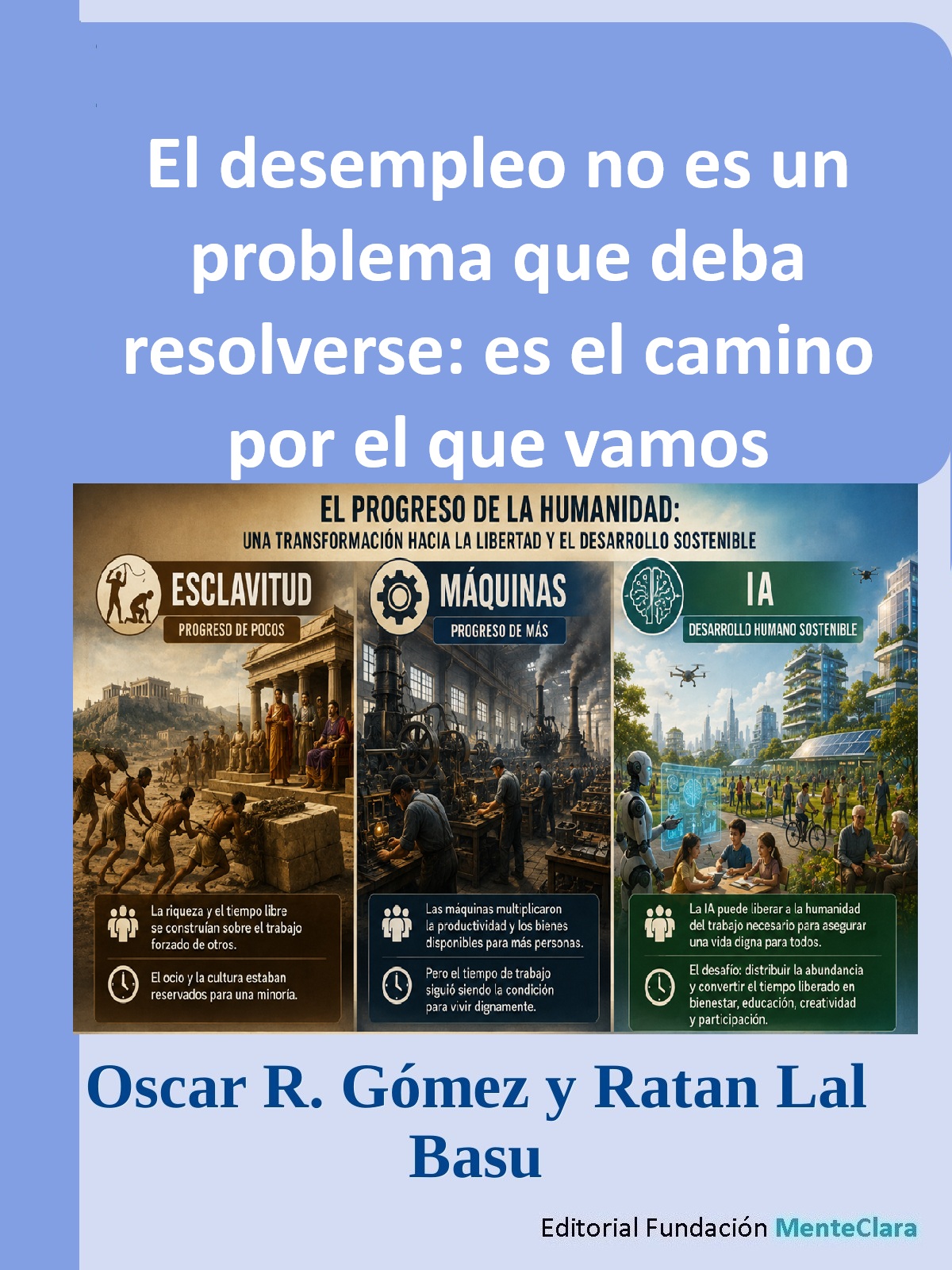
Published
Issue
Section
License
Copyright (c) 2026 MenteClara Foundation’s Peer-reviewed Journal

This work is licensed under a Creative Commons Attribution 4.0 International License.
Authors who publish in this journal agree with the following terms:
a. Authors publish under a Creative Commons Acknowledgment 4.0 International license that allows others to share the work with an authorship acknowledgment of the work and the initial publication in this journal.
b. Authors, who retain their rights after publication, are allowed and encouraged to disseminate their work electronically (for example, in institutional repositories or on their own website) before and during the submission process, as it may result in productive exchanges as well as earlier and greater citations of published works (See The Effect of Open Access).
 Since November 1st, 2018, all articles published in this journal are available under a Creative Commons Acknowledgment 4.0 International license.
How to Cite





 View the