Book Review – Manual de Tantra.
DOI:
https://doi.org/10.32351/rca.v11.420
Keywords:
Tantra, desire, subjectivity, contemporary spirituality, Existential Psychoanalysis, experiential pedagogy, personal transformation, technology of desire, discourse analysis, alternative educationAbstract
This review analyzes Manual de Tantra. Del tantra a la tecnología del deseo® by Oscar R. Gómez, highlighting its distinctive integration of tantric tradition, psychoanalysis, discourse analysis, and experiential pedagogy aimed at subjective transformation. Drawing on an interdisciplinary background and extensive experience in Eastern spiritual practices, the author develops a method for teaching tantra adapted to contemporary life, free from superstition and reductive cultural or erotic interpretations.
The book systematizes tantra as a technology of desire, understood as an operative form of knowledge capable of intervening in the subject’s relationship with enjoyment, attention, and limits. Throughout twenty-eight chapters, it combines conceptual discussions, practical exercises, and pedagogical devices designed to foster ethical and responsible knowledge transmission. The work emphasizes the reader’s active role as an engaged subject in their own transformative process.
The review underscores the book’s relevance for practitioners, researchers, and educators interested in subjectivity, spirituality, and alternative pedagogies, as well as its significance in the field of systematic tantric training within the contemporary Latin American context.
Downloads
References
Gómez, O. R. (2009). Manual de Tantra: Reprogramación emocional: Desde el tantra a la tecnología del deseo (3.ª ed.). Mente Clara. ISBN 978-987-24510-2-8.
Estadísticas de lectura: 269
Descargas: PDF (SPANISH) 166 - HTML (SPANISH) 87 - XML (SPANISH) 15 - EPUB (SPANISH) 73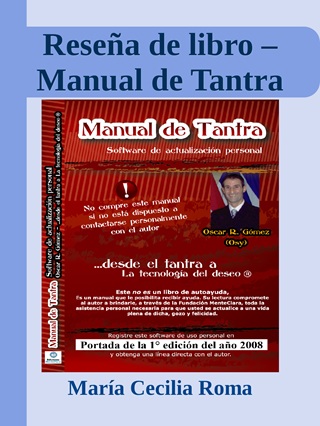
Published
Issue
Section
License
Copyright (c) 2026 MenteClara Foundation’s Peer-reviewed Journal

This work is licensed under a Creative Commons Attribution 4.0 International License.
Authors who publish in this journal agree with the following terms:
a. Authors publish under a Creative Commons Acknowledgment 4.0 International license that allows others to share the work with an authorship acknowledgment of the work and the initial publication in this journal.
b. Authors, who retain their rights after publication, are allowed and encouraged to disseminate their work electronically (for example, in institutional repositories or on their own website) before and during the submission process, as it may result in productive exchanges as well as earlier and greater citations of published works (See The Effect of Open Access).
 Since November 1st, 2018, all articles published in this journal are available under a Creative Commons Acknowledgment 4.0 International license.
How to Cite





 View the