MARCO SPECTRA DE APRENDIZAJE CENTRADO EN EL SER HUMANO: UNA ARQUITECTURA SOCIOTÉCNICA PARA LA EDUCACIÓN SUPERIOR APOYADA POR IA
DOI:
https://doi.org/10.32351/rca.v11.441
Palabras clave:
aprendizaje centrado en el ser humano, educación superior, gobernanza de IA, inteligencia artificial, sistemas sociotécnicosResumen
La inteligencia artificial generativa (IAGen) permite elaborar productos universitarios convincentes, aunque su calidad no permite atribuir automáticamente al estudiante las decisiones que contienen. Este artículo propone una elaboración del Spectra Human-Centered Learning Framework orientada a entornos con IA y reconoce expresamente la formulación anterior: tres condiciones fundacionales, seis fases pedagógicas y cinco proposiciones que aquí se conservan. Mediante síntesis conceptual crítica de bibliografía seleccionada intencionalmente, se distinguen las funciones del ciclo formativo y se examina cómo pueden intervenir la asistencia de IA, la responsabilidad intelectual y las condiciones institucionales. El resultado es una arquitectura teórica que relaciona insumos del mundo real, encuadre conceptual, participación, producción, evaluación y transferencia; no es una intervención implementada. Las proposiciones heredadas se mantienen literalmente y se acompañan de interpretaciones y posibles criterios de refutación para investigaciones futuras. La ampliación, la dependencia y la sustitución designan relaciones provisionales entre personas y sistemas a escala de tarea, no perfiles validados del alumnado. El contraste selectivo con otras propuestas delimita el aporte sin reclamar eficacia o prioridad general. No se recogieron datos de estudiantes ni se realizó una revisión sistemática. Queda por examinar si la organización propuesta favorece razonamiento independiente, accesibilidad y transferencia en contextos distintos.
Descargas
Referencias
Ates, H. (2026). Human-centered GenAI feedback design in higher education: A multisite experiment on direct, reflective, and hybrid approaches to scientific argumentation. International Journal of Educational Technology in Higher Education, 23, Article 38. https://doi.org/10.1186/s41239-026-00614-9
Barnett, S. M., & Ceci, S. J. (2002). When and where do we apply what we learn? A taxonomy for far transfer. Psychological Bulletin, 128(4), 612–637. https://doi.org/10.1037/0033-2909.128.4.612
Baxter, G., & Sommerville, I. (2011). Socio-technical systems: From design methods to systems engineering. Interacting with Computers, 23(1), 4–17. https://doi.org/10.1016/j.intcom.2010.07.003
Biggs, J. (1996). Enhancing teaching through constructive alignment. Higher Education, 32, 347–364. https://doi.org/10.1007/BF00138871
Bond, M., Khosravi, H., De Laat, M., Bergdahl, N., Negrea, V., Oxley, E., Pham, P., Chong, S. W., & Siemens, G. (2024). A meta systematic review of artificial intelligence in higher education: A call for increased ethics, collaboration, and rigour. International Journal of Educational Technology in Higher Education, 21, Article 4. https://doi.org/10.1186/s41239-023-00436-z
Chapman, B. L., & Dalgarno, B. (2026). Beyond the ban: A theoretical framework for integrating generative AI in assessment. Policy Futures in Education, 24(5), 670–682. https://doi.org/10.1177/14782103251411725
Chávez Márquez, I. L., & De los Ríos Chávez, H. J. (2025). Uso personal y académico de inteligencia artificial en estudiantes universitarios: estudio exploratorio. Apertura, 17(1), 54–69. https://doi.org/10.32870/ap.v17n1.2604
Freeman, S., Eddy, S. L., McDonough, M., Smith, M. K., Okoroafor, N., Jordt, H., & Wenderoth, M. P. (2014). Active learning increases student performance in science, engineering, and mathematics. Proceedings of the National Academy of Sciences, 111(23), 8410–8415. https://doi.org/10.1073/pnas.1319030111
Gulikers, J. T. M., Bastiaens, T. J., & Kirschner, P. A. (2004). A five-dimensional framework for authentic assessment. Educational Technology Research and Development, 52(3), 67–86. https://doi.org/10.1007/BF02504676
Hamadeh, S., & Amin, H. (2025). AI, education and digital sovereignty. Frontiers in Education, 10, Article 1677727. https://doi.org/10.3389/feduc.2025.1677727
Jaakkola, E. (2020). Designing conceptual articles: Four approaches. AMS Review, 10(1–2), 18–26. https://doi.org/10.1007/s13162-020-00161-0
Jabareen, Y. (2009). Building a conceptual framework: Philosophy, definitions, and procedure. International Journal of Qualitative Methods, 8(4), 49–62. https://doi.org/10.1177/160940690900800406
Kahu, E. R. (2013). Framing student engagement in higher education. Studies in Higher Education, 38(5), 758–773. https://doi.org/10.1080/03075079.2011.598505
Kasneci, E., Sessler, K., Küchemann, S., Bannert, M., Dementieva, D., Fischer, F., Gasser, U., Groh, G., Günnemann, S., Hüllermeier, E., Krusche, S., Kutyniok, G., Michaeli, T., Nerdel, C., Pfeffer, J., Poquet, O., Sailer, M., Schmidt, A., Seidel, T., Kasneci, G. (2023). ChatGPT for good? On opportunities and challenges of large language models for education. Learning and Individual Differences, 103, Article 102274. https://doi.org/10.1016/j.lindif.2023.102274
Lee, H.-P. H., Sarkar, A., Tankelevitch, L., Drosos, I., Rintel, S., Banks, R., & Wilson, N. (2025). The impact of generative AI on critical thinking: Self-reported reductions in cognitive effort and confidence effects from a survey of knowledge workers. Proceedings of the 2025 CHI Conference on Human Factors in Computing Systems, Article 1121, 1–22. https://doi.org/10.1145/3706598.3713778
Li, C., Cui, H., & Hagedorn, L. S. (2026). The cognitive impact of ChatGPT in higher education: A systematic review of critical and creative thinking outcomes. Computers and Education: Artificial Intelligence, 10, Article 100571. https://doi.org/10.1016/j.caeai.2026.100571
Lintner, T. (2024). A systematic review of AI literacy scales. npj Science of Learning, 9, Article 50. https://doi.org/10.1038/s41539-024-00264-4
López Ayala, M. (2026). Spectra Human-Centered Learning Framework: A human-centered and socio-technical model for cross-disciplinary university learning (Version 1) [Conceptual manuscript and accompanying figure]. Mendeley Data. https://doi.org/10.17632/fvfcw7898h.1
Mayer, R. E. (2020). Multimedia learning (3rd ed.). Cambridge University Press. https://doi.org/10.1017/9781316941355
OECD. (2026). Policies supporting responsible and systematic GenAI adoption in higher education (OECD Education Spotlights, No. 23). OECD Publishing. https://doi.org/10.1787/c4e5621f-en
Oliveira, M., Zednik, C., Bombaerts, G., Sadowski, B., & Conijn, R. (2025). Assessing students’ DRIVE: A framework to evaluate learning through interactions with generative AI. Computers and Education: Artificial Intelligence, 9, Article 100497. https://doi.org/10.1016/j.caeai.2025.100497
Panadero, E. (2017). A review of self-regulated learning: Six models and four directions for research. Frontiers in Psychology, 8, Article 422. https://doi.org/10.3389/fpsyg.2017.00422
Ryan, R. M., & Deci, E. L. (2020). Intrinsic and extrinsic motivation from a self-determination theory perspective: Definitions, theory, practices, and future directions. Contemporary Educational Psychology, 61, Article 101860. https://doi.org/10.1016/j.cedpsych.2020.101860
Shneiderman, B. (2020). Human-centered artificial intelligence: Reliable, safe & trustworthy. International Journal of Human–Computer Interaction, 36(6), 495–504. https://doi.org/10.1080/10447318.2020.1741118
Snyder, H. (2019). Literature review as a research methodology: An overview and guidelines. Journal of Business Research, 104, 333–339. https://doi.org/10.1016/j.jbusres.2019.07.039
Torraco, R. J. (2005). Writing integrative literature reviews: Guidelines and examples. Human Resource Development Review, 4(3), 356–367. https://doi.org/10.1177/1534484305278283
Uden, L., & Hwang, G.-J. (2026). The LEARN framework for responsible use of generative AI in education: A neuroscience-informed model for problem-based learning. Journal of Computers in Education. Advance online publication. https://doi.org/10.1007/s40692-026-00398-x
Valentini, A. (2026). Adopción y gobernanza de la IA en la educación superior de América Latina y el Caribe: resultados de una encuesta regional. Revista Educación Superior y Sociedad, 37(2), 372–397. https://doi.org/10.54674/ess.v37i2.1278
Vendrell, M., & Johnston, S.-K. (2026). Scaffolding critical thinking with generative AI: Design principles for integrating large language models in higher education. Computers and Education: Artificial Intelligence, 10, Article 100572. https://doi.org/10.1016/j.caeai.2026.100572
Xu, X., Qiao, L., Cheng, N., Liu, H., & Zhao, W. (2025). Enhancing self-regulated learning and learning experience in generative AI environments: The critical role of metacognitive support. British Journal of Educational Technology, 56(5), 1842–1863. https://doi.org/10.1111/bjet.13599
Zawacki-Richter, O., Marín, V. I., Bond, M., & Gouverneur, F. (2019). Systematic review of research on artificial intelligence applications in higher education—Where are the educators? International Journal of Educational Technology in Higher Education, 16, Article 39. https://doi.org/10.1186/s41239-019-0171-0
Estadísticas de lectura: 34
Descargas: PDF (INGLÉS) 15 - HTML (INGLÉS) 5 - XML (INGLÉS) 2 - EPUB (INGLÉS) 1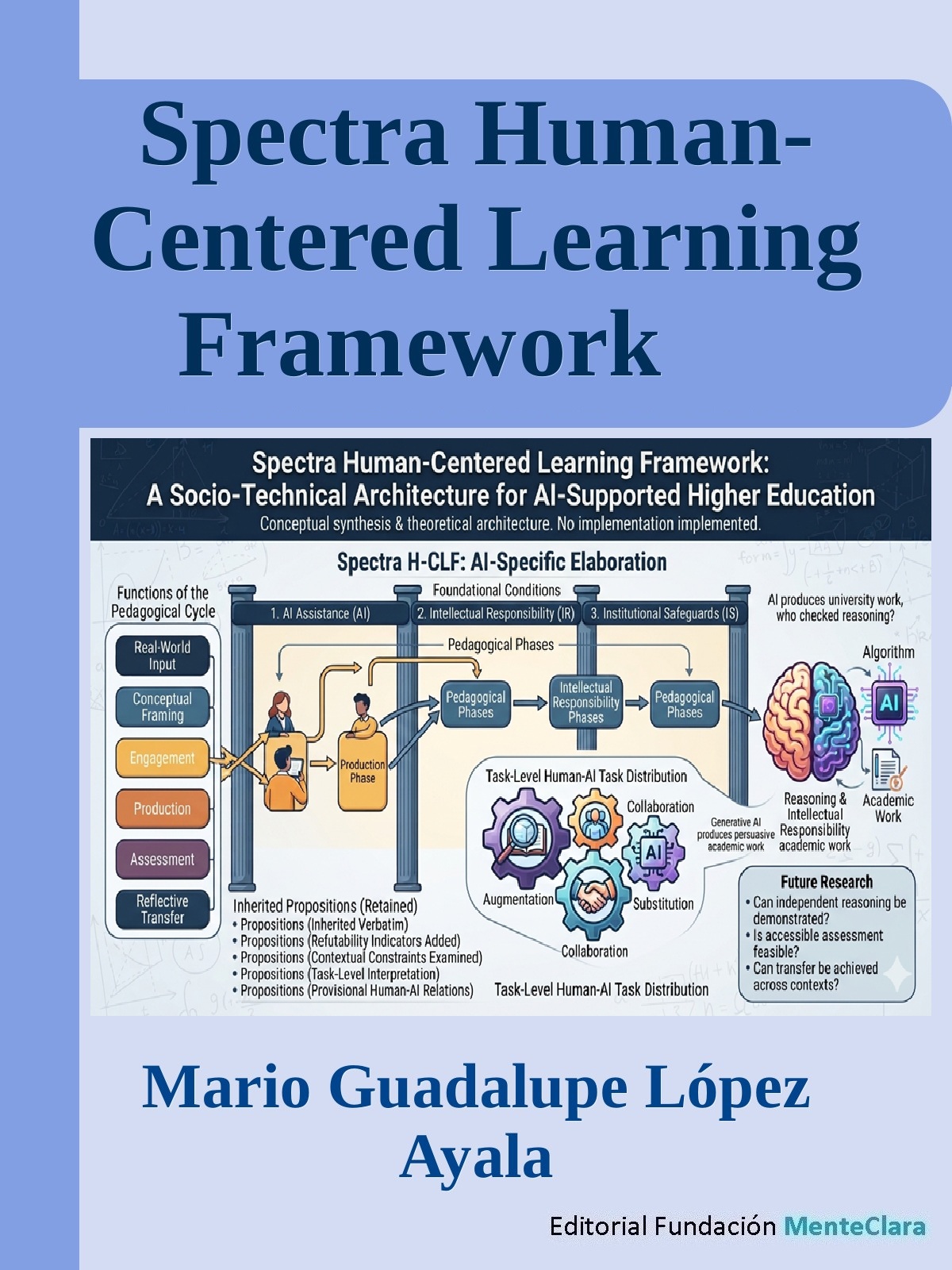
Descargas
Publicado
Número
Sección
Licencia
Derechos de autor 2026 Revista Científica Arbitrada de la Fundación MenteClara

Esta obra está bajo una licencia internacional Creative Commons Atribución 4.0.
Los autores que publican en esta revista están de acuerdo con los siguientes términos:
- Los autores publican bajo una licencia de Creative Commons Reconocimiento 4.0 Internacional que permite a otros compartir el trabajo con un reconocimiento de la autoría del trabajo y la publicación inicial en esta revista.
- Se permite y se anima a los autores, quienes conservan sus derechos luego de la publicación, a difundir sus trabajos electrónicamente (por ejemplo, en repositorios institucionales o en su propio sitio web) antes y durante el proceso de envío, ya que puede dar lugar a intercambios productivos, así como a una citación más temprana y mayor de los trabajos publicados (Véase The Effect of Open Access).

Desde el 1º de noviembre de 2018 todos los artículos de esta revista están disponibles bajo una licencia de Creative Commons Reconocimiento 4.0 Internacional.
Cómo citar





 Consultar