Spectra Human-Centered Learning Framework: A Socio-Technical Architecture for AI-Supported Higher Education
DOI:
https://doi.org/10.32351/rca.v11.441
Keywords:
AI governance, artificial intelligence, higher education, human-centered learning, socio-technical systemsAbstract
Generative artificial intelligence (GenAI) can produce persuasive university work without revealing who performed or checked the reasoning behind it. This conceptual article develops an AI-specific elaboration of the previously disseminated Spectra Human-Centered Learning Framework. Its three foundational conditions, six pedagogical phases and five original propositions are retained, not presented as new inventions. A purposive, critical synthesis distinguishes the functions of the pedagogical cycle and examines how AI assistance, intellectual responsibility, institutional safeguards and contextual constraints may intersect with them. The resulting architecture connects real-world input, conceptual framing, engagement, production, assessment and reflective transfer. The inherited propositions remain verbatim; task-level interpretations, candidate indicators and conditions that might challenge them are added for future research. Augmentation, dependency and substitution describe provisional distributions of work between learners and systems, not validated learner types. A targeted comparison with adjacent frameworks identifies overlaps and the specific scope of this elaboration without claiming global novelty or superiority. No student data were collected, no intervention was implemented and no systematic literature search was conducted. Whether the configuration supports independently defensible learning, accessible assessment and transfer across contexts remains an empirical question.
Downloads
References
Ates, H. (2026). Human-centered GenAI feedback design in higher education: A multisite experiment on direct, reflective, and hybrid approaches to scientific argumentation. International Journal of Educational Technology in Higher Education, 23, Article 38. https://doi.org/10.1186/s41239-026-00614-9
Barnett, S. M., & Ceci, S. J. (2002). When and where do we apply what we learn? A taxonomy for far transfer. Psychological Bulletin, 128(4), 612–637. https://doi.org/10.1037/0033-2909.128.4.612
Baxter, G., & Sommerville, I. (2011). Socio-technical systems: From design methods to systems engineering. Interacting with Computers, 23(1), 4–17. https://doi.org/10.1016/j.intcom.2010.07.003
Biggs, J. (1996). Enhancing teaching through constructive alignment. Higher Education, 32, 347–364. https://doi.org/10.1007/BF00138871
Bond, M., Khosravi, H., De Laat, M., Bergdahl, N., Negrea, V., Oxley, E., Pham, P., Chong, S. W., & Siemens, G. (2024). A meta systematic review of artificial intelligence in higher education: A call for increased ethics, collaboration, and rigour. International Journal of Educational Technology in Higher Education, 21, Article 4. https://doi.org/10.1186/s41239-023-00436-z
Chapman, B. L., & Dalgarno, B. (2026). Beyond the ban: A theoretical framework for integrating generative AI in assessment. Policy Futures in Education, 24(5), 670–682. https://doi.org/10.1177/14782103251411725
Chávez Márquez, I. L., & De los Ríos Chávez, H. J. (2025). Uso personal y académico de inteligencia artificial en estudiantes universitarios: estudio exploratorio. Apertura, 17(1), 54–69. https://doi.org/10.32870/ap.v17n1.2604
Freeman, S., Eddy, S. L., McDonough, M., Smith, M. K., Okoroafor, N., Jordt, H., & Wenderoth, M. P. (2014). Active learning increases student performance in science, engineering, and mathematics. Proceedings of the National Academy of Sciences, 111(23), 8410–8415. https://doi.org/10.1073/pnas.1319030111
Gulikers, J. T. M., Bastiaens, T. J., & Kirschner, P. A. (2004). A five-dimensional framework for authentic assessment. Educational Technology Research and Development, 52(3), 67–86. https://doi.org/10.1007/BF02504676
Hamadeh, S., & Amin, H. (2025). AI, education and digital sovereignty. Frontiers in Education, 10, Article 1677727. https://doi.org/10.3389/feduc.2025.1677727
Jaakkola, E. (2020). Designing conceptual articles: Four approaches. AMS Review, 10(1–2), 18–26. https://doi.org/10.1007/s13162-020-00161-0
Jabareen, Y. (2009). Building a conceptual framework: Philosophy, definitions, and procedure. International Journal of Qualitative Methods, 8(4), 49–62. https://doi.org/10.1177/160940690900800406
Kahu, E. R. (2013). Framing student engagement in higher education. Studies in Higher Education, 38(5), 758–773. https://doi.org/10.1080/03075079.2011.598505
Kasneci, E., Sessler, K., Küchemann, S., Bannert, M., Dementieva, D., Fischer, F., Gasser, U., Groh, G., Günnemann, S., Hüllermeier, E., Krusche, S., Kutyniok, G., Michaeli, T., Nerdel, C., Pfeffer, J., Poquet, O., Sailer, M., Schmidt, A., Seidel, T., Kasneci, G. (2023). ChatGPT for good? On opportunities and challenges of large language models for education. Learning and Individual Differences, 103, Article 102274. https://doi.org/10.1016/j.lindif.2023.102274
Lee, H.-P. H., Sarkar, A., Tankelevitch, L., Drosos, I., Rintel, S., Banks, R., & Wilson, N. (2025). The impact of generative AI on critical thinking: Self-reported reductions in cognitive effort and confidence effects from a survey of knowledge workers. Proceedings of the 2025 CHI Conference on Human Factors in Computing Systems, Article 1121, 1–22. https://doi.org/10.1145/3706598.3713778
Li, C., Cui, H., & Hagedorn, L. S. (2026). The cognitive impact of ChatGPT in higher education: A systematic review of critical and creative thinking outcomes. Computers and Education: Artificial Intelligence, 10, Article 100571. https://doi.org/10.1016/j.caeai.2026.100571
Lintner, T. (2024). A systematic review of AI literacy scales. npj Science of Learning, 9, Article 50. https://doi.org/10.1038/s41539-024-00264-4
López Ayala, M. (2026). Spectra Human-Centered Learning Framework: A human-centered and socio-technical model for cross-disciplinary university learning (Version 1) [Conceptual manuscript and accompanying figure]. Mendeley Data. https://doi.org/10.17632/fvfcw7898h.1
Mayer, R. E. (2020). Multimedia learning (3rd ed.). Cambridge University Press. https://doi.org/10.1017/9781316941355
OECD. (2026). Policies supporting responsible and systematic GenAI adoption in higher education (OECD Education Spotlights, No. 23). OECD Publishing. https://doi.org/10.1787/c4e5621f-en
Oliveira, M., Zednik, C., Bombaerts, G., Sadowski, B., & Conijn, R. (2025). Assessing students’ DRIVE: A framework to evaluate learning through interactions with generative AI. Computers and Education: Artificial Intelligence, 9, Article 100497. https://doi.org/10.1016/j.caeai.2025.100497
Panadero, E. (2017). A review of self-regulated learning: Six models and four directions for research. Frontiers in Psychology, 8, Article 422. https://doi.org/10.3389/fpsyg.2017.00422
Ryan, R. M., & Deci, E. L. (2020). Intrinsic and extrinsic motivation from a self-determination theory perspective: Definitions, theory, practices, and future directions. Contemporary Educational Psychology, 61, Article 101860. https://doi.org/10.1016/j.cedpsych.2020.101860
Shneiderman, B. (2020). Human-centered artificial intelligence: Reliable, safe & trustworthy. International Journal of Human–Computer Interaction, 36(6), 495–504. https://doi.org/10.1080/10447318.2020.1741118
Snyder, H. (2019). Literature review as a research methodology: An overview and guidelines. Journal of Business Research, 104, 333–339. https://doi.org/10.1016/j.jbusres.2019.07.039
Torraco, R. J. (2005). Writing integrative literature reviews: Guidelines and examples. Human Resource Development Review, 4(3), 356–367. https://doi.org/10.1177/1534484305278283
Uden, L., & Hwang, G.-J. (2026). The LEARN framework for responsible use of generative AI in education: A neuroscience-informed model for problem-based learning. Journal of Computers in Education. Advance online publication. https://doi.org/10.1007/s40692-026-00398-x
Valentini, A. (2026). Adopción y gobernanza de la IA en la educación superior de América Latina y el Caribe: resultados de una encuesta regional. Revista Educación Superior y Sociedad, 37(2), 372–397. https://doi.org/10.54674/ess.v37i2.1278
Vendrell, M., & Johnston, S.-K. (2026). Scaffolding critical thinking with generative AI: Design principles for integrating large language models in higher education. Computers and Education: Artificial Intelligence, 10, Article 100572. https://doi.org/10.1016/j.caeai.2026.100572
Xu, X., Qiao, L., Cheng, N., Liu, H., & Zhao, W. (2025). Enhancing self-regulated learning and learning experience in generative AI environments: The critical role of metacognitive support. British Journal of Educational Technology, 56(5), 1842–1863. https://doi.org/10.1111/bjet.13599
Zawacki-Richter, O., Marín, V. I., Bond, M., & Gouverneur, F. (2019). Systematic review of research on artificial intelligence applications in higher education—Where are the educators? International Journal of Educational Technology in Higher Education, 16, Article 39. https://doi.org/10.1186/s41239-019-0171-0
Estadísticas de lectura: 34
Descargas: PDF 15 - HTML 5 - XML 2 - EPUB 1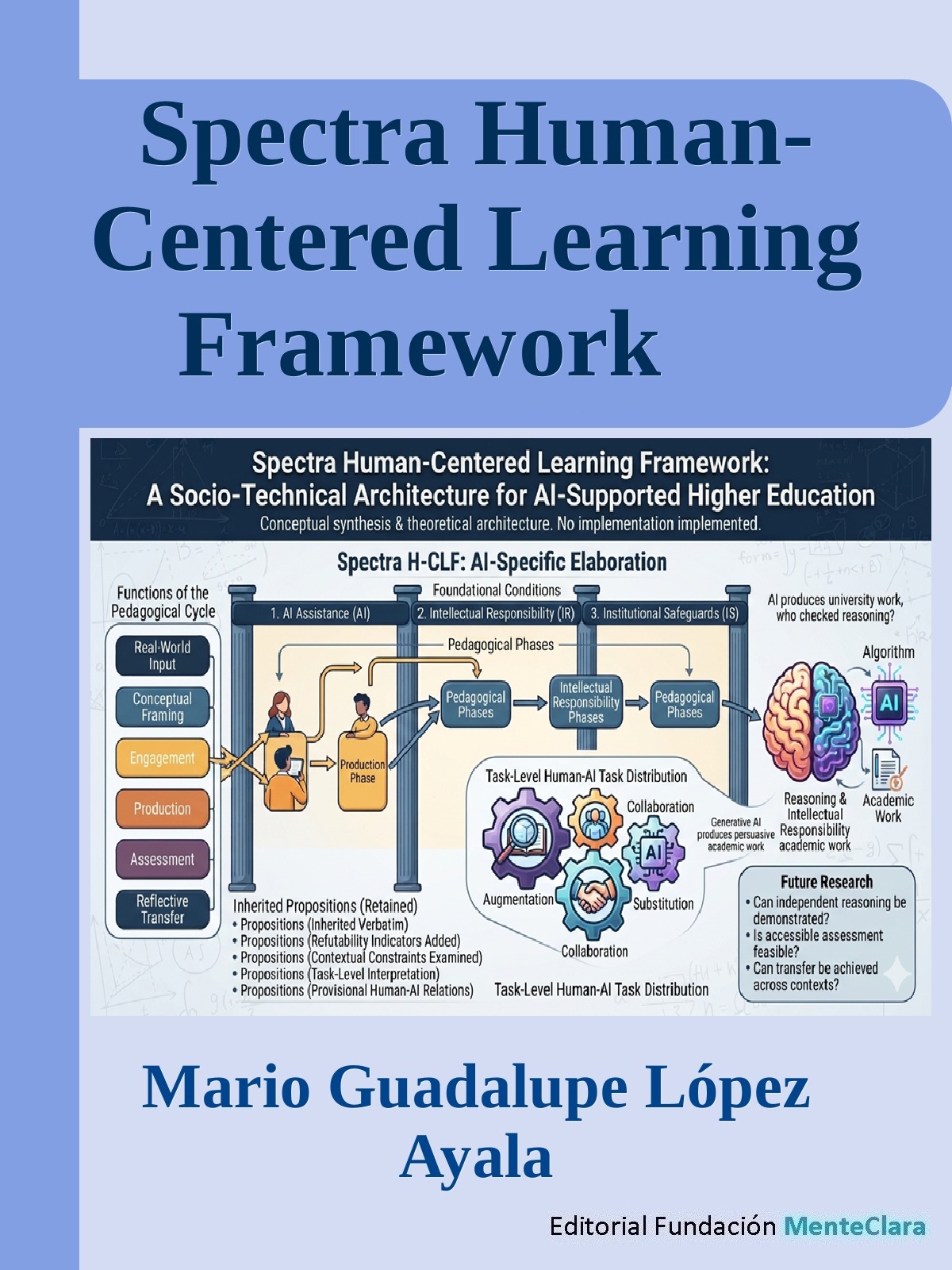
Published
Issue
Section
License
Copyright (c) 2026 MenteClara Foundation’s Peer-reviewed Journal

This work is licensed under a Creative Commons Attribution 4.0 International License.
Authors who publish in this journal agree with the following terms:
a. Authors publish under a Creative Commons Acknowledgment 4.0 International license that allows others to share the work with an authorship acknowledgment of the work and the initial publication in this journal.
b. Authors, who retain their rights after publication, are allowed and encouraged to disseminate their work electronically (for example, in institutional repositories or on their own website) before and during the submission process, as it may result in productive exchanges as well as earlier and greater citations of published works (See The Effect of Open Access).
 Since November 1st, 2018, all articles published in this journal are available under a Creative Commons Acknowledgment 4.0 International license.
How to Cite





 View the