RESEARCH COMPETENCIES: AN ANALYSIS OF UNIVERSITY TEACHERS
DOI:
https://doi.org/10.32351/rca.v11.433
Keywords:
teaching, research, skillsAbstract
Academic research requires university faculty to develop theoretical, methodological, and multidisciplinary competencies that enable them to generate solutions to the problems facing contemporary society. In this context, the research competencies of university faculty in the southern region of the country were analyzed. This was carried out through a quantitative, descriptive, non-experimental, and cross-sectional study involving a sample of 128 undergraduate faculty members from the Autonomous University of Campeche, Mexico. Participants completed an eight-item questionnaire via Google Forms. The results revealed a moderate overall level of research competence: 37.5% of the faculty scored at a high level, 29.7% at a moderate level, and 32.8% at a low level. The primary strength lay in the formulation and substantiation of research problems, whereas the main areas for improvement were data analysis, instrumentation, and proficiency in languages and general knowledge. Additionally, significant gender-based differences were identified, with men demonstrating higher levels of research competence in almost all evaluated areas. In conclusion, the faculty possess the foundations for conducting research and disseminating knowledge, particularly regarding problem formulation and the construction of theoretical frameworks. However, it is necessary to strengthen skills in statistical analysis and instrument validation through increased institutional support, project-based learning, and expert guidance in order to enhance research competencies and narrow the gender gap.
Downloads
References
Álvarez-Ochoa, R., Román-Collazo, C. A., Conchado-Martínez, J., & Cordero-Cordero, G. (2020). Habilidades investigativas en docentes de educación superior: un acercamiento a la realidad. Revista Ciencias Pedagógicas e Innovación, 8(1), 70–77. https://doi.org/10.26423/rcpi.v8i1.370
Barbachán Ruales, E. A., Casimiro Urcos, W. H., Casimiro Urcos, C. N., Pacovilca Alejo, O. V., & Pacovilca Alejo, G. S. (2021). Habilidades investigativas en estudiantes de áreas tecnológicas. Universidad y Sociedad, 13(4), 218-225. http://scielo.sld.cu/scielo.php?script=sci_arttext&pid=S2218-36202021000400218
Barrutia Barreto, I., Acosta Roa, E. R., & Marín Velásquez, T. D. (2019). Producción científica de profesores en Universidades Peruanas: motivaciones y percepciones. San Gregorio, (35), 70-80. doi: http://dx.doi.org/10.36097/rsan.v1i35.1140
Berkeley, A. (2004). Research skills for management studies. New York: Routledge.
Campos, C. J., & Chincilla, J, A. (2009). Reflexiones acerca de los desafíos en la formación de competencias para la investigación en educación superioforzando. Actualidades investigativas en educación, 9 (2), 1-20.
Casimiro Urcos, W. H., Ramos Ticlla, F., Casimiro Urcos, C. N., Barbachán Ruales, E. A., & Casimiro Urcos, J. F. (2021). Competencias investigativas de los docentes de las universidades de Lima, Perú. Universidad y Sociedad, 13(4), 302-308. https://rus.ucf.edu.cu/index.php/rus/article/view/2169
Chávez Vera, K. J., Ayasta Llontop, L., Kong Nunton, I., & Gonzales Dávila, J. S. (2022). Formación de competencias investigativas en los estudiantes de la Universidad Señor de Sipán en Perú. Revista de Ciencias Sociales (RCS), 27(1), 250-260. doi: https://doi.org/10.31876/rcs.v28i1.37689
Cruz L., Cuevas E. M. y Hernández E. (2019). El desarrollo de competencias para la investigación durante la formación inicial. COSEIN. México.
Dávila Morán, R. C., Martin-Bogdanovich, M. M., Ferrer Mejía, M. L., & López Gómez, H. E. (2022). Habilidades investigativas y producción intelectual en docentes de una universidad pública peruana. Revista Universidad y Sociedad, 14(4), 495-504.
Díaz, J., Álvarez, F., Fabara, J., & Peña, D. (2022). Cultura y competencia investigativa: importancia en la formación de los estudiantes de pregrado. Revista Sinapsis, 1(21), 1-20. https://doi.org/10.37117/s.v21i1.472
Díaz-Cruz, V., Saavedra-Carrion, N. P., & del Pilar Zevallos-Delgado, K. (2024). Competencia Investigativa y Desarrollo Profesional Docente. Revista Docentes 2.0, 17(1), 261-270.
Dipp, A. (2013). Competencias investigativas: Una mirada a la Educación Superior. Red Durango de Investigadores Educativos.
Estrada Molina, O. (2014). Sistematización teórica sobre la competencia investigativa. Revista Electrónica Educare, 18(2), 177–194. https://doi.org/10.15359/ree.18-2.9
Guamán Gómez, V. J., Herrera Martínez, L., & Espinoza Freire, E. E. (2020). Las competencias investigativas como imperativo para la formación de conocimientos en la universidad actual. Conrado. Revista Pedagógica de la Universidad de Cienfuegos, 16(72), 83-88. https://conrado.ucf.edu.cu/index.php/conrado/article/view/1220
Moreno Bayardo, M. G. (2011). La formación de investigadores como elemento para la consolidación de la investigación en la universidad. Revista de la educación superior, 40(158), 59-78.
Ordorika, I. (2015). Equidad de género en la Educación Superior. Revista de la Educación Superior. 2 (174), 7-17.
Orozco-Colcha, O. D. C., y Esteves-Fajardo, Z. I. E. (2023). Aprendizaje Significativo Critico. Una articulación renovadora de la formación educativa. CIENCIAMATRIA, 9(1), 318-332.
Rivera, H. M., Arango, P. L., & Torres, V. C. (2014). Competencias para la Investigación. Desarrollo de habilidades y conceptos. México: Trillas.
Rodríguez, A., Comendeiro, I., & Pérez, W. (2014). Caracterización de habilidades científico-investigativas en un colectivo de profesores de Química. Panorama. Cuba y Salud, 4(1), 38-45.
Yangali Vicente, J. S., Vasquez Tomás, M. R., Huaita Acha, D. M., & Luza Castillo, F. F. (2020). Cultura de investigación y competencias investigativas de docentes universitarios del sur de Lima. Revista Venezolana de Gerencia (RVG), 25(91), 1159-1179. doi: https://doi.org/10.37960/rvg.v25i91.33197
Estadísticas de lectura: 150
Descargas: PDF (SPANISH) 78 - HTML (SPANISH) 18 - XML (SPANISH) 11 - EPUB (SPANISH) 18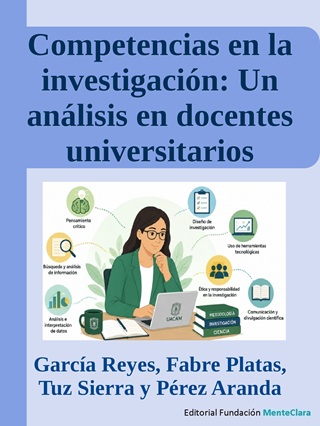
Published
Issue
Section
License
Copyright (c) 2026 MenteClara Foundation’s Peer-reviewed Journal

This work is licensed under a Creative Commons Attribution 4.0 International License.
Authors who publish in this journal agree with the following terms:
a. Authors publish under a Creative Commons Acknowledgment 4.0 International license that allows others to share the work with an authorship acknowledgment of the work and the initial publication in this journal.
b. Authors, who retain their rights after publication, are allowed and encouraged to disseminate their work electronically (for example, in institutional repositories or on their own website) before and during the submission process, as it may result in productive exchanges as well as earlier and greater citations of published works (See The Effect of Open Access).
 Since November 1st, 2018, all articles published in this journal are available under a Creative Commons Acknowledgment 4.0 International license.
How to Cite





 View the