HOW TO WRITE AND PUBLISH SCIENTIFIC ARTICLES: A PRACTICAL GUIDE FOR RESEARCHERS AND EDITORS OF PEER-REVIEWED JOURNALS
DOI:
https://doi.org/10.32351/rca.v11.431
Keywords:
Academic writing, Scientific writing, Research methodology, Scientific articlesAbstract
This book offers a practical and rigorous guide for researchers who wish to transform their work into publishable scientific articles. Unlike traditional methodology manuals or editorial guidelines, this work addresses the intermediate space: the moment when researchers must communicate their knowledge to the scientific community. With over forty years of experience in research and two decades as an editor, Oscar R. Gómez guides the reader from the research question to the life of the article after publication. The book explains the logic behind each section of the scientific article, common errors that lead to rejection, the editorial process, publication ethics, and the current challenges of scientific communication in the digital age. Its central metaphor —science as a conversation that spans generations— provides unity to a work that combines conceptual depth with expository clarity. Written in an accessible yet rigorous style, it is intended for novice researchers, doctoral students, experienced academics, editors, and methodology instructors. A book that invites us to rethink scientific publication not as a curricular requirement, but as an act of intellectual responsibility.
Downloads
References
Gómez, O. R. (2026). Cómo escribir y publicar artículos científicos: guía práctica para investigadores y editores de Revistas Arbitradas. MenteClara. 978-987-24510-5-9
Estadísticas de lectura: 347
Descargas: PDF (SPANISH) 184 - HTML (SPANISH) 81 - XML (SPANISH) 27 - EPUB (SPANISH) 44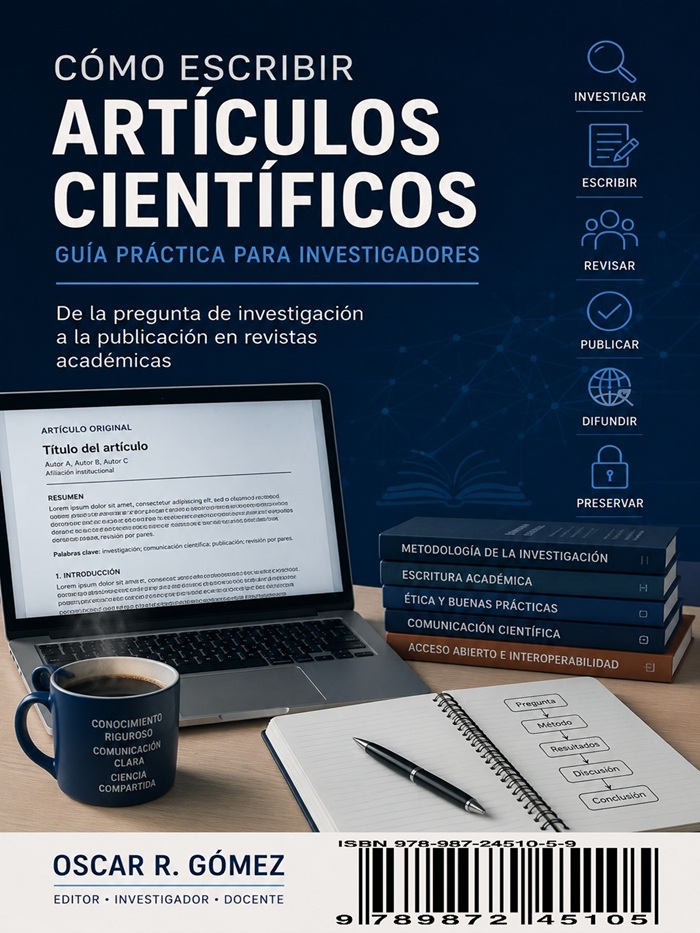
Published
Issue
Section
License
Copyright (c) 2026 MenteClara Foundation’s Peer-reviewed Journal

This work is licensed under a Creative Commons Attribution 4.0 International License.
Authors who publish in this journal agree with the following terms:
a. Authors publish under a Creative Commons Acknowledgment 4.0 International license that allows others to share the work with an authorship acknowledgment of the work and the initial publication in this journal.
b. Authors, who retain their rights after publication, are allowed and encouraged to disseminate their work electronically (for example, in institutional repositories or on their own website) before and during the submission process, as it may result in productive exchanges as well as earlier and greater citations of published works (See The Effect of Open Access).
 Since November 1st, 2018, all articles published in this journal are available under a Creative Commons Acknowledgment 4.0 International license.
How to Cite





 View the