(Re)Tracing the Radical Poetics and Vision of Guru Nanak: A Socio-Political Perspective
DOI:
https://doi.org/10.32351/rca.v8.341
Keywords:
Indian History, Philosophies, Emancipatory vision, Revolutionary poetics, Comparative analysisAbstract
The entire landscape of Northern Indian religious practices underwent a sea change in the 15th and 16th centuries with Nirgun Saint poets like Kabir, and Guru Nanak. Nanak invariably became one of the leading voices of his times whose modernist vision can be visualized through his poetics. His egalitarian worldview has made him popular amongst all sections of society. Choosing a linguistic idiom of the masses he refuted the consecrated value rendered to scriptures, invalidated many prevalent notions of Karma Kand (Vedic rituals) and its hegemonic approach and showed a revolutionary path to devotion. His Japji sahib is a cultural model of co-existential plurality resistive to rigid authoritarianism and entails a democratized mysticism. It’s a unique philosophy that dismantles the regressive upholders of repressive ideologies. His Shabads and Gurbani in the Guru Granth Sahib are poetics of plurality offering an alternative model of openness and multidimensionality. Reminiscent of the style of English Romantics, in Nanak, the mundane and commonplace gets elevated to larger significance in his poetry. The rationality, equality and liberal ideology preached and rendered in his poetics stands in stark opposition to the irrationality, inequality and orthodoxy prevalent. The important rationale of Nanak’s philosophy is the psychological freedom it accords to those despised and dispossessed because of caste, class, and gender. It moves beyond the boundaries of community, religion, language, culture and nation. The consequential philosophy of holistic liberation becomes more relevant in a multilingual, multicultural, multireligious Indian ethos today. This paper therefore, shall explore the radical, emancipatory potential in the poetics of Guru Nanak, its contemporary relevance in an age of religious polarizations, bigotry and divisiveness; Further, it explores how the pluralistic paradigms of Guru Nanak’s vision and poetics become a panacea to the ongoing invasions on secular democratic beliefs.
Downloads
References
Bose, Lanjewar A. (2019) “Emancipatory Buddhist Dhamma: Reflections and Challenges” in Re-Markings (A Biannual Refereed International Journal of English Letters) edited by Nibir Ghosh.Vol.18. No.2 Sept.2019, 92-102. ISSN 0972-611X
Bose, A. (2019). Hacia una poética comparativa de Buda, Kabir y Gurú Nanak desde una perspectiva democrática secular. Revista Científica Arbitrada de la Fundación MenteClara, Vol. 4(2), 19-44 (85). doi: https://doi.org/10.32351/rca.v4.2.85
Hawley, JS. And Mark Juergensmeyer. (2004)Songs of the Saints of India. New York and Delhi: Oxford University Press
Karine Schomer (1979) “Kabir in the Guru Granth Sahib, An exploratory essay.” in Sikh Studies: Comparative Perspective on a Changing Tradition edited by Mark Juergensmeyer and N. G. Barrier. Berkeley: Berkeley Religious Studies Series and Graduate Theological Unions
Grewal, J S. (1979) Guru Nanak in History, Chandigarh: Punjab University
Gurinder S M (2010) “Guru Nanak Life and Legacy: An Appraisal” Journal of Punjab Studies Volume 17.1-2
Mcleod, W. H. (1969) Guru Nanak and the Sikh Religion. Oxford: Clarendon Press.
Mcleod, W. H. (1997) Sikhism. London; New York: Penguin Books
Randhawa G.S. (1998) Guru Nanak’s As Di Var. Amritsar: Guru Nanak Dev University Press.
Singh Piar (1996) Guru Nanak’s Siddha Goshti. Amritsar: Guru Nanak Dev University Press.
Estadísticas de lectura: 1375
Descargas: PDF 534 - HTML 426 - XML 245 - EPUB 284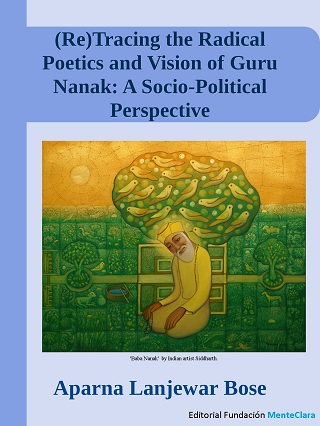
Published
Issue
Section
License
Authors who publish in this journal agree with the following terms:
a. Authors publish under a Creative Commons Acknowledgment 4.0 International license that allows others to share the work with an authorship acknowledgment of the work and the initial publication in this journal.
b. Authors, who retain their rights after publication, are allowed and encouraged to disseminate their work electronically (for example, in institutional repositories or on their own website) before and during the submission process, as it may result in productive exchanges as well as earlier and greater citations of published works (See The Effect of Open Access).
 Since November 1st, 2018, all articles published in this journal are available under a Creative Commons Acknowledgment 4.0 International license.
How to Cite





 View the