TRACEMI: MODELO MULTIVECTORIAL PROPUESTO DE CONSTRUCCIÓN DE SIGNIFICADOS EDUCATIVOS Y CAPACIDAD EFECTIVA DE ACCIÓN
DOI:
https://doi.org/10.32351/rca.v11.471
Palabras clave:
TRACEMI, mentoría educativa, síntesis teórica, modelo conceptual, divergencia interpretativa, agencia relacional, acción factible, contexto espaciotemporal, educación comparada, agencia condicionadaResumen
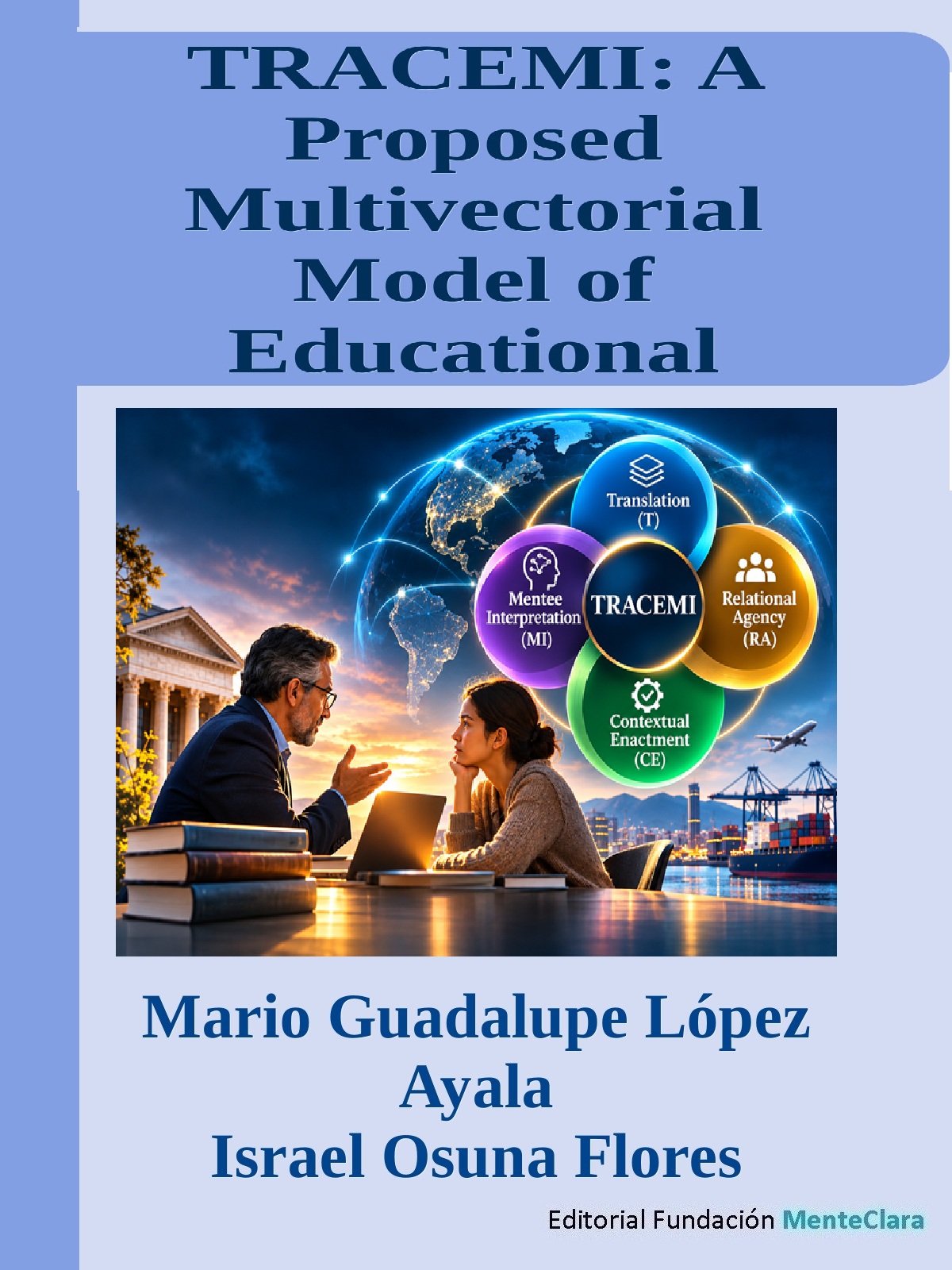
Este artículo presenta TRACEMI —Traducción, Agencia Relacional, Implementación Contextual e Interpretación del Estudiante— como un modelo multivectorial propuesto para investigar cómo la orientación educativa adquiere significado y puede traducirse en acciones dentro de relaciones institucionales de mentoría. El problema central consiste en distinguir lo que las instituciones pretenden, lo que los mentores realizan, lo que los estudiantes interpretan y las posibilidades reales de acción bajo condiciones sociales cambiantes. El modelo establece tres distinciones analíticas: divergencia institucional–práctica (D1), divergencia relacional–interpretativa (D2) y discontinuidad entre interpretación y acción (D3). La agencia relacional opera mediante negociación y retroalimentación, mientras que las condiciones institucionales, socioeconómicas, socioculturales, territoriales, ambientales y de seguridad pueden influir en las trayectorias educativas a través del tiempo histórico, institucional y relacional. El diseño metodológico combina síntesis teórica y construcción de modelos siguiendo a Jaakkola (2020). La evidencia de Rusia, China, Inglaterra, Finlandia y México se organiza según mecanismos pertinentes, sin asumir equivalencia nacional. La contribución propuesta reside en la integración de estas relaciones y en diez proposiciones que orientan su investigación empírica futura. TRACEMI se presenta como una propuesta conceptual original aún no validada empíricamente; no se afirman efectos causales ni superioridad explicativa demostrada.
Descargas
Referencias
Ajzen, I. (1991). The theory of planned behavior. Organizational Behavior and Human Decision Processes, 50(2), 179–211. https://doi.org/10.1016/0749-5978(91)90020-T
Alonso, N. A., Marshall, A., Porter, C., & Kraiger, K. (2024). Co-creating successful mentoring relationships? Investigating mentor and protégé perceptions of dyadic fit and relationship quality. Journal of Managerial Psychology, 39(6), 635–650. https://doi.org/10.1108/JMP-02-2023-0084
Ball, S. J., Maguire, M., Braun, A., & Hoskins, K. (2011). Policy actors: Doing policy work in schools. Discourse: Studies in the Cultural Politics of Education, 32(4), 625–639. https://doi.org/10.1080/01596306.2011.601565
Braun, A., Ball, S. J., Maguire, M., & Hoskins, K. (2011). Taking context seriously: Towards explaining policy enactments in the secondary school. Discourse: Studies in the Cultural Politics of Education, 32(4), 585–596. https://doi.org/10.1080/01596306.2011.601555
Bronfenbrenner, U., & Morris, P. A. (2006). The bioecological model of human development. In R. M. Lerner (Ed.), Handbook of child psychology: Vol. 1. Theoretical models of human development (6th ed., pp. 793–828). Wiley.
Coria López, P. J., & Pineda Castillo, K. A. (2026). Experiencia de estudiantes de bachillerato en tiempos de violencia en Sinaloa. Revista Construyendo Paz Latinoamericana, 11(24). https://doi.org/10.35600/25008870.2026.24.0423
Corley, K. G., & Gioia, D. A. (2011). Building theory about theory building: What constitutes a theoretical contribution? Academy of Management Review, 36(1), 12–32. https://doi.org/10.5465/amr.2009.0486
Elder, G. H., Jr. (1998). The life course as developmental theory. Child Development, 69(1), 1–12. https://doi.org/10.1111/j.1467-8624.1998.tb06128.x
Emirbayer, M., & Mische, A. (1998). What is agency? American Journal of Sociology, 103(4), 962–1023. https://doi.org/10.1086/231294
Fagenson-Eland, E. A., Baugh, S. G., & Lankau, M. J. (2005). Seeing eye to eye: A dyadic investigation of the effect of relational demography on perceptions of mentoring activities. Career Development International, 10(6/7), 460–477. https://doi.org/10.1108/13620430510620557
Fominykh, I., Kozlov, V., Romanov, D., & Rosenberg, D. (2026). Patriotic education in Russia: Will it achieve loyalty? Post-Soviet Affairs, 42(5), 575–605. https://doi.org/10.1080/1060586X.2026.2643798
Heeneman, S., & de Grave, W. (2019). Development and initial validation of a dual-purpose questionnaire capturing mentors' and mentees' perceptions and expectations of the mentoring process. BMC Medical Education, 19, Article 133. https://doi.org/10.1186/s12909-019-1574-2
Hernán, M. A., & Robins, J. M. (2020). Causal inference: What if. Chapman & Hall/CRC.
Hobson, A. J., & Malderez, A. (2013). Judgementoring and other threats to realizing the potential of school-based mentoring in teacher education. International Journal of Mentoring and Coaching in Education, 2(2), 89–108. https://doi.org/10.1108/IJMCE-03-2013-0019
Jaakkola, E. (2020). Designing conceptual articles: Four approaches. AMS Review, 10, 18–26. https://doi.org/10.1007/s13162-020-00161-0
Jarillo, B., Magaloni, B., Franco, E., & Robles, G. (2016). How the Mexican drug war affects kids and schools? Evidence on effects and mechanisms. International Journal of Educational Development, 51, 135–146. https://doi.org/10.1016/j.ijedudev.2016.05.008
Kim, H. Y., Tubbs Dolan, C., Aber, J. L., Diazgranados, S., Pherali, T., & ERICC Research Programme Consortium. (2026). A conceptual framework for education research in conflict and protracted crisis (ERICC): A holistic approach for systematic field building. Educational Researcher, 55(3), 204–211. https://doi.org/10.3102/0013189X251406243
Kram, K. E. (1985). Mentoring at work: Developmental relationships in organizational life. Scott, Foresman.
Lee, J. C.-K., & Feng, S. (2007). Mentoring support and the professional development of beginning teachers: A Chinese perspective. Mentoring & Tutoring: Partnership in Learning, 15(3), 243–262. https://doi.org/10.1080/13611260701201760
Lessing, B. (2021). Conceptualizing criminal governance. Perspectives on Politics, 19(3), 854–873. https://doi.org/10.1017/S1537592720001243
Li, X., & Lu, L. (2025). School quality matters: How mentoring can be restructured to support beginning teachers in different schools from a social capital perspective. Research Papers in Education, 40(2), 213–235. https://doi.org/10.1080/02671522.2024.2368496
López Ayala, M. G., & Osuna Flores, I. (2026). Tutorías universitarias en México: alcances y límites de la evidencia para atribuir efectos educativos. Una revisión integrativa crítica desde el marco CIPRA. Revista Científica Arbitrada de la Fundación MenteClara, 11, 455. https://doi.org/10.32351/rca.v11.455
Lunsford, L. G., Luo, L., & Stoeger, H. (2025). The influence of national culture on the initiation of mentoring in a STEMM talent development program: Mentors' perspectives. Humanities and Social Sciences Communications, 12, Article 1352. https://doi.org/10.1057/s41599-025-05072-8
Meyer, J. W., & Rowan, B. (1977). Institutionalized organizations: Formal structure as myth and ceremony. American Journal of Sociology, 83(2), 340–363. https://doi.org/10.1086/226550
National Academies of Sciences, Engineering, and Medicine. (2019). The science of effective mentorship in STEMM. The National Academies Press. https://doi.org/10.17226/25568
Nuis, W., Segers, M., & Beausaert, S. (2023). Conceptualizing mentoring in higher education: A systematic literature review. Educational Research Review, 41, Article 100565. https://doi.org/10.1016/j.edurev.2023.100565
Pawson, R., & Tilley, N. (1997). Realistic evaluation. SAGE Publications.
Raposa, E. B., Erickson, L. D., Hagler, M., & Rhodes, J. E. (2018). How economic disadvantage affects the availability and nature of mentoring relationships during the transition to adulthood. American Journal of Community Psychology, 61(1–2), 191–203. https://doi.org/10.1002/ajcp.12228
Rehman, R., Javaid, Q., Khalid, S., Ali, T. S., & Ali, R. (2026). Applying the realist evaluation framework to a faculty mentorship program: A context–mechanism–outcome analysis at a private medical university. BMC Medical Education, 26, Article 287. https://doi.org/10.1186/s12909-025-08458-z
Rhodes, J. E., Spencer, R., Keller, T. E., Liang, B., & Noam, G. (2006). A model for the influence of mentoring relationships on youth development. Journal of Community Psychology, 34(6), 691–707. https://doi.org/10.1002/jcop.20124
Robinson, W. S. (1950). Ecological correlations and the behavior of individuals. American Sociological Review, 15(3), 351–357. https://doi.org/10.2307/2087176
Sambunjak, D. (2015). Understanding wider environmental influences on mentoring: Towards an ecological model of mentoring in academic medicine. Acta Medica Academica, 44(1), 47–57. https://doi.org/10.5644/ama2006-124.126
Schunk, D. H., & Mullen, C. A. (2013). Toward a conceptual model of mentoring research: Integration with self-regulated learning. Educational Psychology Review, 25(3), 361–389. https://doi.org/10.1007/s10648-013-9233-3
Sen, A. (1999). Development as Freedom. Alfred A. Knopf.
Spencer, R., Drew, A. L., & Gowdy, G. (2023). Going the distance: A longitudinal qualitative study of formal youth mentoring relationship development. Journal of Community Psychology, 51(8), 3083–3102. https://doi.org/10.1002/jcop.23006
Suurmond, J., Kruithof, K., & Harting, J. (2023). Does mentoring improve the health of people in the community? A realist evaluation. Journal of Social Work, 23(3), 463–484. https://doi.org/10.1177/14680173221144411
Tikhonova, N. V., Ratner, F. L., & Vergasova, I. Y. (2024). Mentoring in education: An analysis of international practices and their implementation in Russia. The Education and Science Journal, 26(5), 124–151. https://doi.org/10.17853/1994-5639-2024-5-124-151
Tynjälä, P., Pennanen, M., Markkanen, I., & Heikkinen, H. L. T. (2021). Finnish model of peer-group mentoring: Review of research. Annals of the New York Academy of Sciences, 1483(1), 208–223. https://doi.org/10.1111/nyas.14296
Voyvodic, C., & Sagherian-Dickey, T. (2025). Raising children under fire: Civilian agency and intergenerational transmission in Colombia, Northern Ireland and Lebanon. Cooperation and Conflict. Advance online publication. https://doi.org/10.1177/00108367251348108
Whetten, D. A. (1989). What constitutes a theoretical contribution? Academy of Management Review, 14(4), 490–495. https://doi.org/10.5465/amr.1989.4308371
Xu, J., Wei, X., Hisrich, R. D., Yu, M., & Li, X. (2022). Mentoring and tacit knowledge transfer in novice teachers from Chinese middle schools: Mediating effect of job crafting. Frontiers in Education, 7, Article 772638. https://doi.org/10.3389/feduc.2022.772638
Yang, H., & Fairbrother, G. P. (2026). State legitimation and its incorporation of ideological-political education teachers in China, 1979–2023. Journal of Contemporary China. Advance online publication. https://doi.org/10.1080/10670564.2026.2740552
Descargas
Publicado
Número
Sección
Licencia
Derechos de autor 2026 Revista Científica Arbitrada de la Fundación MenteClara

Esta obra está bajo una licencia internacional Creative Commons Atribución 4.0.
Los autores que publican en esta revista están de acuerdo con los siguientes términos:
- Los autores publican bajo una licencia de Creative Commons Reconocimiento 4.0 Internacional que permite a otros compartir el trabajo con un reconocimiento de la autoría del trabajo y la publicación inicial en esta revista.
- Se permite y se anima a los autores, quienes conservan sus derechos luego de la publicación, a difundir sus trabajos electrónicamente (por ejemplo, en repositorios institucionales o en su propio sitio web) antes y durante el proceso de envío, ya que puede dar lugar a intercambios productivos, así como a una citación más temprana y mayor de los trabajos publicados (Véase The Effect of Open Access).

Desde el 1º de noviembre de 2018 todos los artículos de esta revista están disponibles bajo una licencia de Creative Commons Reconocimiento 4.0 Internacional.
Cómo citar





 Consultar