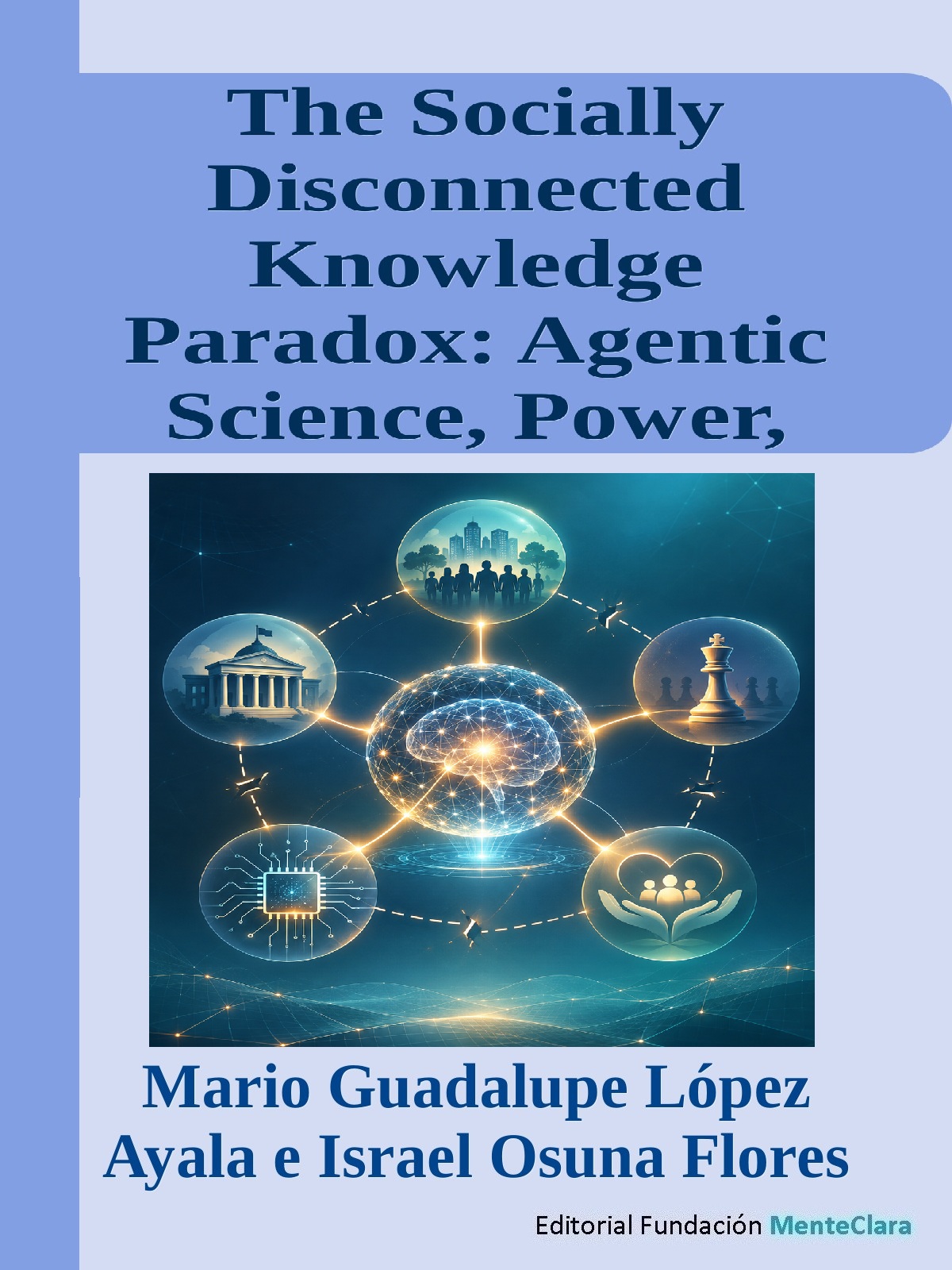
THE SOCIALLY DISCONNECTED KNOWLEDGE PARADOX: AGENTIC SCIENCE, POWER, CRIMINAL GOVERNANCE, AND SOCIETAL VALUE
DOI:
https://doi.org/10.32351/rca.v11.462
Keywords:
Socially Disconnected Knowledge Paradox, agentic artificial intelligence, scientific knowledge, authority–control–value disconnection, criminal governance, societal valueAbstract
The expansion of agentic artificial intelligence is transforming scientific discovery, yet growing scientific capabilities do not necessarily yield corresponding improvements in societal well-being. This article develops the Socially Disconnected Knowledge Paradox (SDKP) as a conceptual framework examining how the application and societal value of scientific knowledge depend on policy authority, legal entitlement, effective operational control, and institutional capacity. Integrating innovation studies, institutional economics, science policy, research impact assessment, and criminal-governance scholarship, SDKP introduces authority–control–value disconnection as its central construct. It distinguishes implementation disconnection, in which governance or resource constraints impede the use of scientifically supported knowledge, from distributional disconnection, in which an effective application does not deliver its intended breadth of benefits because of identifiable access or appropriation arrangements. The article formulates six conditional propositions, proposes an analytical protocol, and identifies directions for comparative research. Organized criminal interference is included only when evidence establishes its relevance to a particular scientific application. The proposed distinctions are conceptual and require independent empirical assessment.
Downloads
References
Bianchini, S., Di Girolamo, V., Ravet, J., & Arranz, D. (2026). AI in science: When and where it makes a difference. Research Policy, 55(6), Article 105478. https://doi.org/10.1016/j.respol.2026.105478
Bianchini, S., Müller, M., & Pelletier, P. (2025). Drivers and barriers of AI adoption and use in scientific research. Technological Forecasting and Social Change, 220, Article 124303. https://doi.org/10.1016/j.techfore.2025.124303
Cohen, W. M., & Levinthal, D. A. (1990). Absorptive capacity: A new perspective on learning and innovation. Administrative Science Quarterly, 35(1), 128–152. https://doi.org/10.2307/2393553
Di Cataldo, M., & Mastrorocco, N. (2022). Organized crime, captured politicians, and the allocation of public resources. The Journal of Law, Economics, and Organization, 38(3), 774–839. https://doi.org/10.1093/jleo/ewab015
Farrell, H., & Newman, A. L. (2019). Weaponized interdependence: How global economic networks shape state coercion. International Security, 44(1), 42–79. https://doi.org/10.1162/isec_a_00351
Feng, B., Walther, P., Zhang, L., Coyle, R. A., Kim, S., Mandal, A., Zhang, Z., Papidocha, S. M., Kelmanson, A., Segura, D. M., Thakur, S., Pal, S. C., Bernales, V., Gao, W., Yang, X., Cong, L., Schwaller, P., Aspuru-Guzik, A., & Zheng, Z. (2026). Agentic AI systems for scientific discovery. Nature Reviews Methods Primers, 6, Article 81. https://doi.org/10.1038/s43586-026-00534-y
Geels, F. W. (2002). Technological transitions as evolutionary reconfiguration processes: A multi-level perspective and a case-study. Research Policy, 31(8–9), 1257–1274. https://doi.org/10.1016/S0048-7333(02)00062-8
Ghareeb, A. E., Chang, B., Mitchener, L., Yiu, A., Szostkiewicz, C. J., Shved, D., Gyimesi, G. J., Laurent, J. M., Wright, S. M., Razzak, M. T., White, A. D., Finnemann, S. C., Hinks, M. M., & Rodriques, S. G. (2026). A multi-agent system for automating scientific discovery. Nature, 655, 497–505. https://doi.org/10.1038/s41586-026-10652-y
Jaakkola, E. (2020). Designing conceptual articles: Four approaches. AMS Review, 10, 18–26. https://doi.org/10.1007/s13162-020-00161-0
Jasanoff, S. (Ed.). (2004). States of knowledge: The co-production of science and the social order. Routledge.
Laplane, A., & Mazzucato, M. (2020). Socializing the risks and rewards of public investments: Economic, policy, and legal issues. Research Policy: X, 2, Article 100008. https://doi.org/10.1016/j.repolx.2020.100008
Lazonick, W., & Mazzucato, M. (2013). The risk–reward nexus in the innovation–inequality relationship: Who takes the risks? Who gets the rewards? Industrial and Corporate Change, 22(4), 1093–1128. https://doi.org/10.1093/icc/dtt019
Lessing, B. (2021). Conceptualizing criminal governance. Perspectives on Politics, 19(3), 854–873. https://doi.org/10.1017/S1537592720001243
Miao, J., Davis, J. R., Zhang, Y., Pritchard, J. K., & Zou, J. (2026). Reimagining research papers as interactive and reliable AI agents. Nature, 658, 1272–1280. https://doi.org/10.1038/s41586-026-11044-y
North, D. C. (1990). Institutions, institutional change and economic performance. Cambridge University Press. https://doi.org/10.1017/CBO9780511808678
Ostrom, E. (2010). Beyond markets and states: Polycentric governance of complex economic systems. American Economic Review, 100(3), 641–672. https://doi.org/10.1257/aer.100.3.641
Spaapen, J., & van Drooge, L. (2011). Introducing ‘productive interactions’ in social impact assessment. Research Evaluation, 20(3), 211–218. https://doi.org/10.3152/095820211X12941371876742
Sutton, R. I., & Staw, B. M. (1995). What theory is not. Administrative Science Quarterly, 40(3), 371–384. https://doi.org/10.2307/2393788
Sørensen, O. H., Jaspers, S. Ø., Garn, S. D., & Nielsen, S. B. (2026). Theorizing societal impact of research: A theory of change for societal impact of research with explicated assumptions. Research Evaluation, 35, rvag043. https://doi.org/10.1093/reseval/rvag043
Teece, D. J. (1986). Profiting from technological innovation: Implications for integration, collaboration, licensing and public policy. Research Policy, 15(6), 285–305. https://doi.org/10.1016/0048-7333(86)90027-2
United Nations Educational, Scientific and Cultural Organization. (2021). Recommendation on the ethics of artificial intelligence. https://www.unesco.org/en/legal-affairs/recommendation-ethics-artificial-intelligence
Whetten, D. A. (1989). What constitutes a theoretical contribution? Academy of Management Review, 14(4), 490–495. https://doi.org/10.5465/amr.1989.4308371
World Bank. (2025). Digital progress and trends report 2025: Strengthening AI foundations. World Bank. https://www.worldbank.org/en/publication/dptr2025-ai-foundations
World Health Organization. (2021). Ethics and governance of artificial intelligence for health: WHO guidance. https://www.who.int/publications/i/item/9789240029200
World Health Organization. (2025). mRNA technology transfer programme. https://www.who.int/initiatives/mrna-technology-transfer-(mrna-tt)-programme
Zahra, S. A., & George, G. (2002). Absorptive capacity: A review, reconceptualization, and extension. Academy of Management Review, 27(2), 185–203. https://doi.org/10.5465/amr.2002.6587995
Zhang, Y., & Wei, S. (2026). Organized crime and firm innovation: The moderating effects of business group affiliation and export intensity. Journal of International Management, 32(2), Article 101343. https://doi.org/10.1016/j.intman.2026.101343
Published
Issue
Section
License
Copyright (c) 2026 MenteClara Foundation’s Peer-reviewed Journal

This work is licensed under a Creative Commons Attribution 4.0 International License.
Authors who publish in this journal agree with the following terms:
a. Authors publish under a Creative Commons Acknowledgment 4.0 International license that allows others to share the work with an authorship acknowledgment of the work and the initial publication in this journal.
b. Authors, who retain their rights after publication, are allowed and encouraged to disseminate their work electronically (for example, in institutional repositories or on their own website) before and during the submission process, as it may result in productive exchanges as well as earlier and greater citations of published works (See The Effect of Open Access).
 Since November 1st, 2018, all articles published in this journal are available under a Creative Commons Acknowledgment 4.0 International license.
How to Cite





 View the