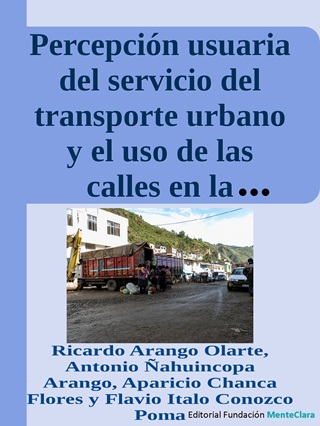
USER PERCEPTION OF THE URBAN TRANSPORTATION SERVICE AND THE USE OF STREETS IN THE TOWN OF LIRCAY (HUANCAVELICA - PERU)
DOI:
https://doi.org/10.32351/rca.v11.432
Keywords:
urban transportation, street usage, urban perception, urban planning, mobilityAbstract
The objective of this study was to determine the relationship between users’ perception of urban transportation services and street usage in the city of Lircay, Huancavelica. A correlational, cross-sectional design was employed with a probabilistic sample of 368 residents. Data were collected through two structured questionnaires organized into dimensions and measured using a Likert scale, both demonstrating adequate reliability according to Cronbach’s α coefficients. Spearman’s correlation was used for the analysis due to the non-normal distribution of the variables. The results indicate that there is no significant relationship between urban transportation and street usage (Rho = 0.07; p = 0.161), although weak correlations were found among some internal dimensions, suggesting the influence of external factors not included in the model. Overall, users reported moderately negative perceptions of the transportation service and neutral perceptions regarding street usage. It is concluded that both variables should be addressed through independent yet complementary strategies, and that incorporating contextual factors such as municipal management, road infrastructure, and transportation informality is essential for a comprehensive understanding of urban dynamics in Lircay.
Downloads
References
Anguita, F., Duarte, B., y Flores, S. (2014). Situación actual del transporte público urbano: la visión de las empresas operadoras. Investigaciones Europeas de Dirección y Economía de la Empresa, *20*(1), 16-22. https://acortar.link/eGkWX3
Bañobre, E., y Romero, Á. (2009). Los BRT en corredores segregados como sistema óptimo de transporte urbano. En Administrando en entornos inciertos. XXIII Congreso Anual AEDEM (pp. 1-20). ESIC. https://hdl.handle.net/11441/77802
Belogi, I., & Mera, G. (2022). Transport and urban territory: Accessibility conditions in Greater Buenos Aires agglomeration. Revista INVI, *37*(105), 174–203. https://doi.org/10.5354/0718-8358.2022.63497
Cendrero, B., y Truyols, S. (2008). El transporte. Aspectos y tipología. Delta Publicaciones.
Comisión Económica para América Latina y el Caribe. (1990). Diagnóstico del Sector Transporte Colectivo en Santiago de Chile: Los efectos de la Desreglamentación. CEPAL. https://repositorio.cepal.org/handle/11362/29623
Fernández, R., Valenzuela, E., y Gálvez, T. (2000). Incorporación de la capacidad y rendimiento de paraderos en el programa TRANSYT. En Actas del XI Congreso Panamericano de Tránsito y Transporte (pp. 221-233). https://acortar.link/SLklfI
Figueroa, M. (2011). Intervención en el espacio público y revitalización del patrimonio cultural del centro histórico de Mixco [Tesis de licenciatura, Universidad del Istmo]. http://glifos.unis.edu.gt/digital/tesis/2012/28074.pdf
Gómez, J. (2001). La experiencia cultural del espacio: el espacio vivido y el espacio abstracto. Una perspectiva ricoeureana. Investigaciones Geográficas, (44), 119-125. https://acortar.link/O4uXW9
Gonzáles, S. (2009). El uso social del espacio público y sus vínculos con el sistema integrado de transporte masivo: caso: Cartagena [Tesis de pregrado?]. https://acortar.link/o1ZLrl
González, S. (2017). Uso social de los espacios públicos o carreteras en relación con el sistema integrado de transporte masivo. Pontificia Universidad Javeriana. https://doi.org/10.11144/Javeriana.10554.227
Hernández-Sampieri, R., & Torres, C. (2018). Metodología de la investigación (Vol. 4). McGraw-Hill Interamericana.
Jacobs, J. (1961). La muerte y la vida de las grandes ciudades americanas. Vintage Books. https://acortar.link/xBqiLm
Krier, L. (2013). La arquitectura de la comunidad, la modernidad tradicional y la ecología del urbanismo. Editorial Reverté. https://acortar.link/tb26YZ
Lefebvre, H. (1991). La producción del espacio. Capitán Swing Libros. https://acortar.link/3mu4hV
Lerma, E. (2013). Espacio vivido: del espacio local al reticular. Notas en torno a la representación social del espacio vivido en la globalización. Revista Pueblos y Fronteras Digital, *8*(15), 225-250. https://doi.org/10.22201/cimsur.18704115e.2013.15.92
Mora, R., Greene, M., y Reyes, A. (2018). Uso y percepción del espacio público en dos barrios vulnerables: Un análisis comparativo de dos barrios. AUS [Arquitectura/Urbanismo/Sustentabilidad], (24), 53-60. https://doi.org/10.4206/aus.2018.n24-08
Pereyra, O. (2003). Suben, bajan: dinámica del transporte urbano en un contexto de precarización acelerada [Documento de trabajo]. Proyecto “Urbanización latinoamericana a finales del siglo XX”.
Romero, G., y Lugo-Morín, D. (2018). El estado del arte de la movilidad del transporte en la vida urbana en ciudades latinoamericanas. Revista Transporte y Territorio, (19), 133-157. https://doi.org/10.34096/rtt.i19.5329
Sánchez, L. (2020). La fiscalización administrativa en el ordenamiento peruano: de la heterogeneidad a la regulación común. IUS ET VERITAS, (60), 38-64. https://doi.org/10.18800/iusetveritas.202001.002
Vásquez, C., Pérez, R., Ramírez, R., y Osal, W. (2019). Sistemas de transporte urbano en Latinoamérica. TRIM: Tordesillas, revista de investigación multidisciplinar, (17), 31-44.
Vidales, A., y Rivera, J. (2012). Metodología para la recuperación de espacios públicos. http://hdl.handle.net/11298/1102
Yago, G. (1983). The sociology of transportation [La sociología del transporte]. Annual Review of Sociology, *9*, 171-190.
Zunino, D., Giucci, G., y Jirón, P. (2017). Transporte. En Términos clave para los estudios de movilidad en América Latina (pp. 179-186). Editorial Biblos. https://acortar.link/wu1e0b
Zúñiga, J. (2016). Micro-simulación peatonal y estudios de vida pública en la calle Marqués de la ciudad del Cusco [Tesis de pregrado, Pontificia Universidad Católica del Perú]. http://hdl.handle.net/20.500.12404/7610
Downloads
Published
Issue
Section
License
Copyright (c) 2026 MenteClara Foundation’s Peer-reviewed Journal

This work is licensed under a Creative Commons Attribution 4.0 International License.
Authors who publish in this journal agree with the following terms:
a. Authors publish under a Creative Commons Acknowledgment 4.0 International license that allows others to share the work with an authorship acknowledgment of the work and the initial publication in this journal.
b. Authors, who retain their rights after publication, are allowed and encouraged to disseminate their work electronically (for example, in institutional repositories or on their own website) before and during the submission process, as it may result in productive exchanges as well as earlier and greater citations of published works (See The Effect of Open Access).
 Since November 1st, 2018, all articles published in this journal are available under a Creative Commons Acknowledgment 4.0 International license.





 View the