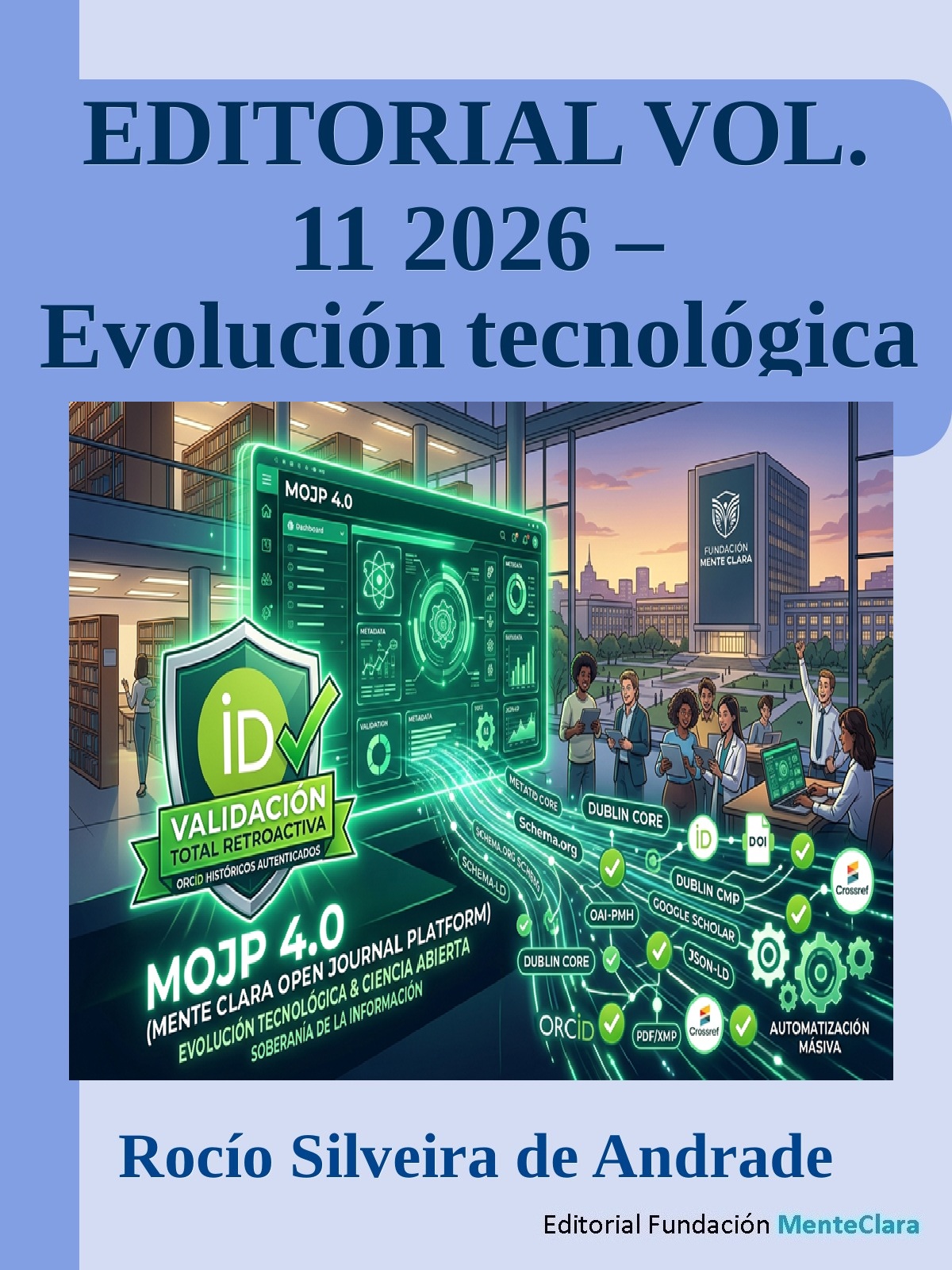
EDITORIAL VOL. 11 2026 – TECHNOLOGICAL EVOLUTION IN THE SERVICE OF SCIENTIFIC COMMUNICATION: MOJP 4.0 AND A NEW STAGE IN EDITORIAL DEVELOPMENT
DOI:
https://doi.org/10.32351/rca.v11.470
Keywords:
Diamond Open Access, Editorial policy, Metadata, Editorial sustainability, MOJP 4.0, scientific communication, editorial infrastructure, scholarly metadata, interoperability, persistent identifiers, OAI-PMH, XMP, Custom Head Injector, OJSAbstract
This editorial presents MOJP 4.0, a technological evolution of the editorial infrastructure of the Peer-Reviewed Scientific Journal of the MenteClara Foundation, developed by Oscar R. Gómez and his engineering team on the basis of OJS 3.5.0.5. It describes its main innovations: optimization of the metadata architecture, implementation of interoperable semantic schemas, improved identification of authors and institutions through persistent identifiers, expansion of OAI-PMH services, and integration of XMP metadata into PDF documents. It also presents Custom Head Injector, a native MOJP 4.0 module compatible with OJS 3.5.0.5 and later versions, which expands the possibilities for customizing and integrating metadata, semantic schemas, and external services into the HTML header of editorial platforms. The editorial also introduces the XMP-PDF Module, a technology designed to enrich scientific documents with structured information about their bibliographic identity, editorial provenance, rights, and other relevant data. These developments are part of an institutional trajectory of innovation, technological autonomy, and commitment to the principles of openness, interoperability, and the circulation of scientific information.
Downloads
References
Barcelona Declaration on Open Research Information, Mitchell, D., Kunze, J., Waltman, L., & Steiner, T. (2026). Open Scholarly Metadata Across Publication Formats - A Literature Review (Version 1.0). Zenodo. https://doi.org/10.5281/zenodo.24084581
Doubrov, B., & von Seggern, D. (2021). PDF 2.0 application note 003: Use of object metadata streams. PDF Association. https://pdfa.org/resource/pdf-2-0-application-note-003-use-of-object-metadata-streams/
Hendricks, G., Tkaczyk, D., Lin, J., & Feeney, P. (2020). Crossref: The sustainable source of community-owned scholarly metadata. Quantitative Science Studies, 1(1), 414–427. https://doi.org/10.1162/qss_a_00022
International Organization for Standardization. (2019). Graphic technology—Extensible metadata platform (XMP)—Part 1: Data model, serialization and core properties (ISO Standard No. 16684-1:2019). https://www.iso.org/standard/75163.html
Rusch-Feja, D. (2002). The Open Archives Initiative and the OAI Protocol for Metadata Harvesting: Rapidly forming a new tier in the scholarly communication infrastructure. Learned Publishing, 15(3), 179–186. https://doi.org/10.1087/095315102320140464
Subirats Coll, I., & Barrueco Cruz, J. M. (2003). Open Archives Initiative. Protocol for Metadata Harvesting (OAI-PMH): Descripción, funciones y aplicaciones de un protocolo. El Profesional de la Información, 12(2), 99–106. https://doi.org/10.1076/epri.12.2.99.15473
Weagley, J., Gelches, E., & Park, J.-R. (2010). Interoperability and metadata quality in digital video repositories: A study of Dublin Core. Journal of Library Metadata, 10(1), 37–57. https://doi.org/10.1080/19386380903546984
Downloads
Published
Issue
Section
License
Copyright (c) 2026 MenteClara Foundation’s Peer-reviewed Journal

This work is licensed under a Creative Commons Attribution 4.0 International License.
Authors who publish in this journal agree with the following terms:
a. Authors publish under a Creative Commons Acknowledgment 4.0 International license that allows others to share the work with an authorship acknowledgment of the work and the initial publication in this journal.
b. Authors, who retain their rights after publication, are allowed and encouraged to disseminate their work electronically (for example, in institutional repositories or on their own website) before and during the submission process, as it may result in productive exchanges as well as earlier and greater citations of published works (See The Effect of Open Access).
 Since November 1st, 2018, all articles published in this journal are available under a Creative Commons Acknowledgment 4.0 International license.
How to Cite





 View the