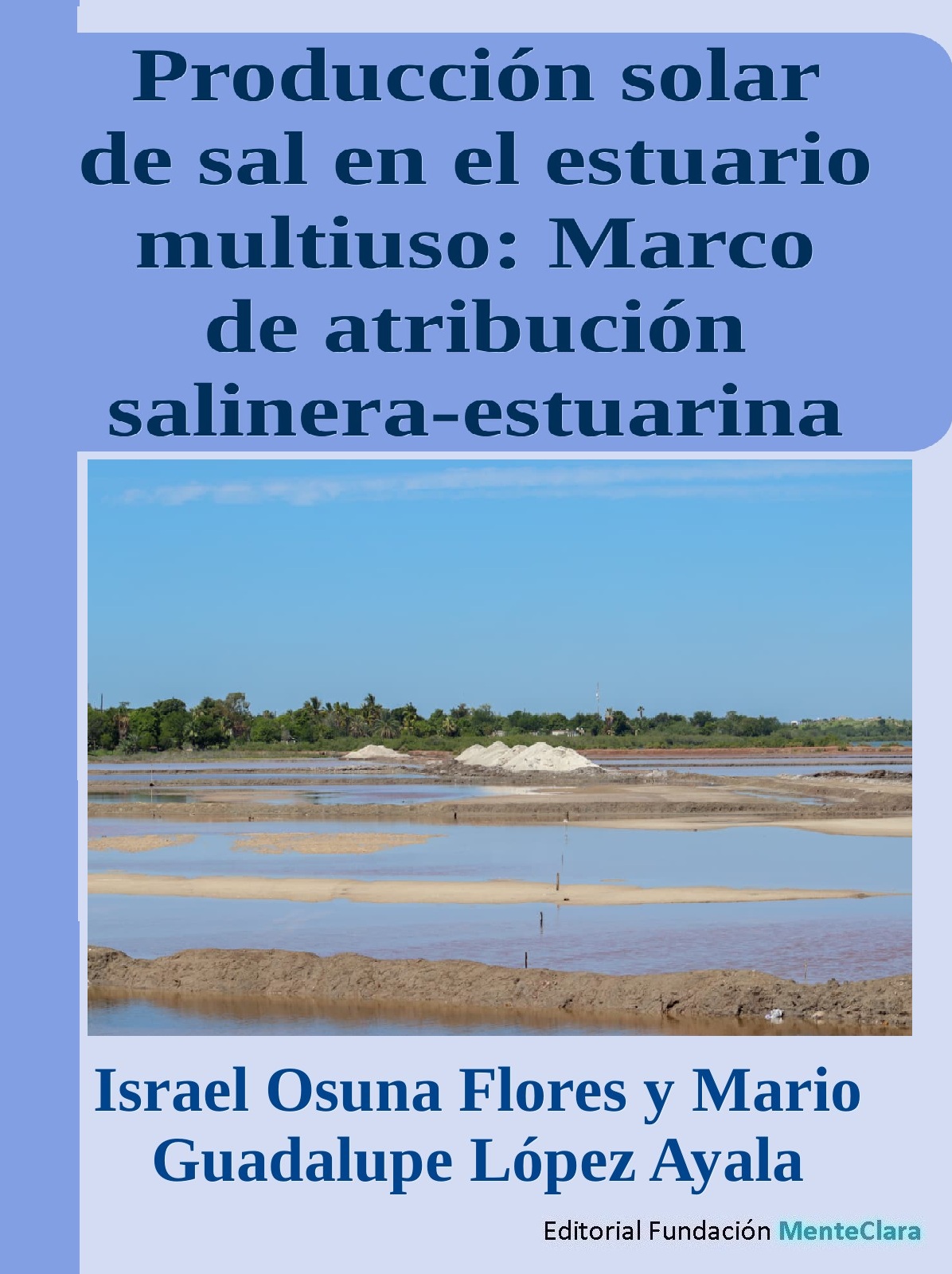
SOLAR SALT PRODUCTION IN A MULTIPURPOSE ESTUARY: SALINITY–ESTUARINE ATTRIBUTION FRAMEWORK (SEAF) FOR MULTICAUSAL ATTRIBUTION ASSESSMENT IN YAVAROS, SONORA, MEXICO
DOI:
https://doi.org/10.32351/rca.v11.447
Keywords:
solar salt production, Yavaros, Yavaros-Moroncarit, effect attribution, SEAF, estuary, cumulative pressures, socioecological response, territorial sustainability, Artemia franciscana, governanceAbstract
Solar salt production depends directly on climate, seawater availability, and hydrological connectivity, yet its potential effects unfold within territories where other activities exert concurrent pressures on many of the same environmental and social variables. Yavaros, Sonora, provides a particularly useful analytical case because its saltworks are associated with the Yavaros-Moroncarit wetland complex, a Wetland of International Importance, and coexist with fisheries, aquaculture, agriculture, wastewater inputs, industrial activities, settlements, and other coastal uses. This integrative review reconstructs the available historical and contemporary evidence, identifies a marked asymmetry between a hydrological and biological baseline documented in 1987 and the limited current characterization of salt-production operations, and develops the Saltworks–Estuary Attribution Framework (SEAF). SEAF distinguishes five substantive domains—dependency, modification, response, distribution, and adaptation—while treating attribution as a cross-cutting inferential layer rather than as a sequential system process. Attribution is evaluated through convergence among plausible mechanism, spatial and temporal correspondence, a comparator or counterfactual, consideration of alternative sources, and explicit uncertainty. The framework links hydrological gradients, physicochemical and biological monitoring, remote sensing, production records, social indicators, and local ecological knowledge. Available evidence does not permit estimation of the contemporary net environmental or social impact of the Yavaros saltworks; it does specify the comparisons and time series required to test attribution hypotheses more rigorously. Salt sustainability is therefore treated as territorially coupled: it cannot be evaluated solely from internal operational performance, but also requires consideration of the integrity and governance of the estuary in which production is embedded.
Downloads
References
Adams, S. M. (2005). Assessing cause and effect of múltiple stressors on marine systems. Marine Pollution Bulletin, 51(8–12), 649–657. https://doi.org/10.1016/j.marpolbul.2004.11.040
Andersen, J. H., Al-Hamdani, Z., Harvey, E. T., Kallenbach, E., Murray, C., & Stock, A. (2020). Relative impacts of multiple human stressors in estuaries and coastal waters in the North Sea–Baltic Sea transition zone. Science of the Total Environment, 704, 135316. https://doi.org/10.1016/j.scitotenv.2019.135316
Comisión Nacional de Acuacultura y Pesca. (2021, 3 de mayo). Realiza Conapesca desazolve del Canal de Comunicación del Estero Moroncarit, Huatabampo. Gobierno de México.
Crain, C. M., Kroeker, K., & Halpern, B. S. (2008). Interactive and cumulative effects of multiple human stressors in marine systems. Ecology Letters, 11(12), 1304–1315. https://doi.org/10.1111/j.1461-0248.2008.01253.x
De Medeiros Rocha, R., Costa, D. F. S., Lucena-Filho, M. A., Bezerra, R. M., Medeiros, D. H. M., Azevedo-Silva, A. M., Araújo, C. N., & Xavier-Filho, L. (2012). Brazilian solar saltworks—Ancient uses and future possibilities. Aquatic Biosystems, 8, 8. http://www.aquaticbiosystems.org/content/8/1/8
Espinosa-Fuentes, M., Ortega-Salas, A. A., & Laguarda-Figueras, A. (1997). Two experimental assays to produce biomass of Artemia franciscana (Anostraca). Revista de Biología Tropical, 44(3)/45(1), 565–572. https://www.semanticscholar.org/paper/Two-experimental-assays-to-produce-biomass-of-Espinosa-Fuentes-Ortega-Salas/d5fdd7499f6415ace34c7d95802b90b9478a9ef7
Ferraro, P. J., & Pattanayak, S. K. (2006). Money for nothing? A call for empirical evaluation of biodiversity conservation investments. PLOS Biology, 4(4): e105. https://doi.org/10.1371/journal.pbio.0040105
Folke, C., Hahn, T., Olsson, P., & Norberg, J. (2005). Adaptive governance of social-ecological systems. Annual Review of Environment and Resources, 30, 441–473. https://doi.org/10.1146/annurev.energy.30.050504.144511
García-Hernández, J., Valdés-Casillas, C., Cadena-Cárdenas, L., Romero-Hernández, S., Silva-Mendizábal, S., González-Pérez, G., Leyva-García, G. N., & Aguilera-Márquez, D. (2011). Humedales artificiales como un método viable para el tratamiento de drenes agrícolas. Revista Mexicana de Ciencias Agrícolas, (1), 97–111. https://www.redalyc.org/pdf/2631/263120987008.pdf
González-Rivas, D. A., Tapia-Silva, F. O., Bustillos-Guzmán, J. J., Revollo-Fernández, D. A., Beltrán-Morales, L. F., Lluch-Cota, D. B., & Ortega-Rubio, A. (2020). Estimating nitrogen runoff from agriculture to coastal zones by a rapid GIS and remote sensing-based method for a case study from the Irrigation District Río Mayo, Gulf of California, México. Frontiers in Marine Science, 7, 316. https://doi.org/10.3389/fmars.2020.00316
Herbert, R. J. H., Broderick, L. G., Ross, K., Moody, C., Cruz, T., Clarke, L., & Stillman, R. A. (2018). Artificial coastal lagoons at solar salt-working sites: A network of habitats for specialised, protected and alien biodiversity. Estuarine, Coastal and Shelf Science, 203, 1–16. https://doi.org/10.1016/j.ecss.2018.01.015
Luque-Agraz, D., Flores-Cuamea, M. A., Kachadourian-Marras, A., Cornejo-Denman, L., & Murphy, A. D. (2025a). Water: The central theme of the proposed Sonora Estuarine Biocultural Corridor of northwestern Mexico. Water, 17(15), 2227. https://doi.org/10.3390/w17152227
Luque-Agraz, D., Flores-Cuamea, M. A., & Rivera-Núñez, I. M. (2025b). Corredor Biocultural Estuarino de Sonora y Norte de Sinaloa: bienestar comunitario y resiliencia climática. Estudios Sociales. Revista de Alimentación Contemporánea y Desarrollo Regional, 35(66), e251616. https://doi.org/10.24836/es.v36i66.1616
Ortega-Salas, A. A., & Martínez G., A. (1987). Hidrological and population studies on <i>Artemia franciscana</i> in Yavaros, Sonora , México. Revista De Biología Tropical, 35(2), 233–239. Retrieved from https://archivo.revistas.ucr.ac.cr/index.php/rbt/article/view/23999
Ostrom, E. (2009). A general framework for analyzing sustainability of social-ecological systems. Science, 325(5939), 419–422. https://doi.org/10.1126/science.1172133
Ramsar Convention on Wetlands. (2010). Humedales de Yavaros-Moroncarit (Ramsar Site No. 1984). Ramsar Sites Information Service.
Saccò, M., White, N. E., Harrod, C., Salazar, G., Aguilar, P., Cubillos, C. F., Meredith, K., Baxter, B. K., Oren, A., Anufriieva, E., Shadrin, N., Marambio-Alfaro, Y., Bravo-Naranjo, V., & Allentoft, M. E. (2021). Salt to conserve: A review on the ecology and preservation of hypersaline ecosystems. Biological Reviews, 96(6), 2828–2850. https://doi.org/10.1111/brv.12780
Servicio Geológico Mexicano. (2025). Anuario estadístico de la minería mexicana 2024, edición 2025. Secretaría de Economía. https://www.sgm.gob.mx/productos/pdf/Anuario_2024_Edicion_2025.pdf
Stockbridge, J., Jones, A. R., Brown, C. J., Doubell, M. J., & Gillanders, B. M. (2025). Incorporating stressor interactions into spatially explicit cumulative impact assessments. Ecological Applications, 35(1), e3056. https://doi.org/10.1002/eap.3056
Underwood, A. J. (1994). On beyond BACI: Sampling designs that might reliably detect environmental disturbances. Ecological Applications, 4(1), 3–15. https://doi.org/10.2307/1942110
Vega-Pozuelo, R. (2026). Inland saltworks and sustainable rural territories: The Duernas socio-ecosystem in the light of the Añana model. Wetlands Ecology and Management, 34, 55. https://doi.org/10.1007/s11273-026-10136-w
Western Hemisphere Shorebird Reserve Network. (2021, mayo). Lagunas Yavaros-Moroncárit. WHSRN. https://whsrn.org/mexico-yavaros-moroncarit-site- 108/
Downloads
Published
Issue
Section
License
Copyright (c) 2026 MenteClara Foundation’s Peer-reviewed Journal

This work is licensed under a Creative Commons Attribution 4.0 International License.
Authors who publish in this journal agree with the following terms:
a. Authors publish under a Creative Commons Acknowledgment 4.0 International license that allows others to share the work with an authorship acknowledgment of the work and the initial publication in this journal.
b. Authors, who retain their rights after publication, are allowed and encouraged to disseminate their work electronically (for example, in institutional repositories or on their own website) before and during the submission process, as it may result in productive exchanges as well as earlier and greater citations of published works (See The Effect of Open Access).
 Since November 1st, 2018, all articles published in this journal are available under a Creative Commons Acknowledgment 4.0 International license.
How to Cite





 View the