Technological Evolution: Introducing MOJP 4.0, the New Editorial Platform of the Fundación Mente Clara Journal
Dear academic community, researchers, editors, and subscribers:
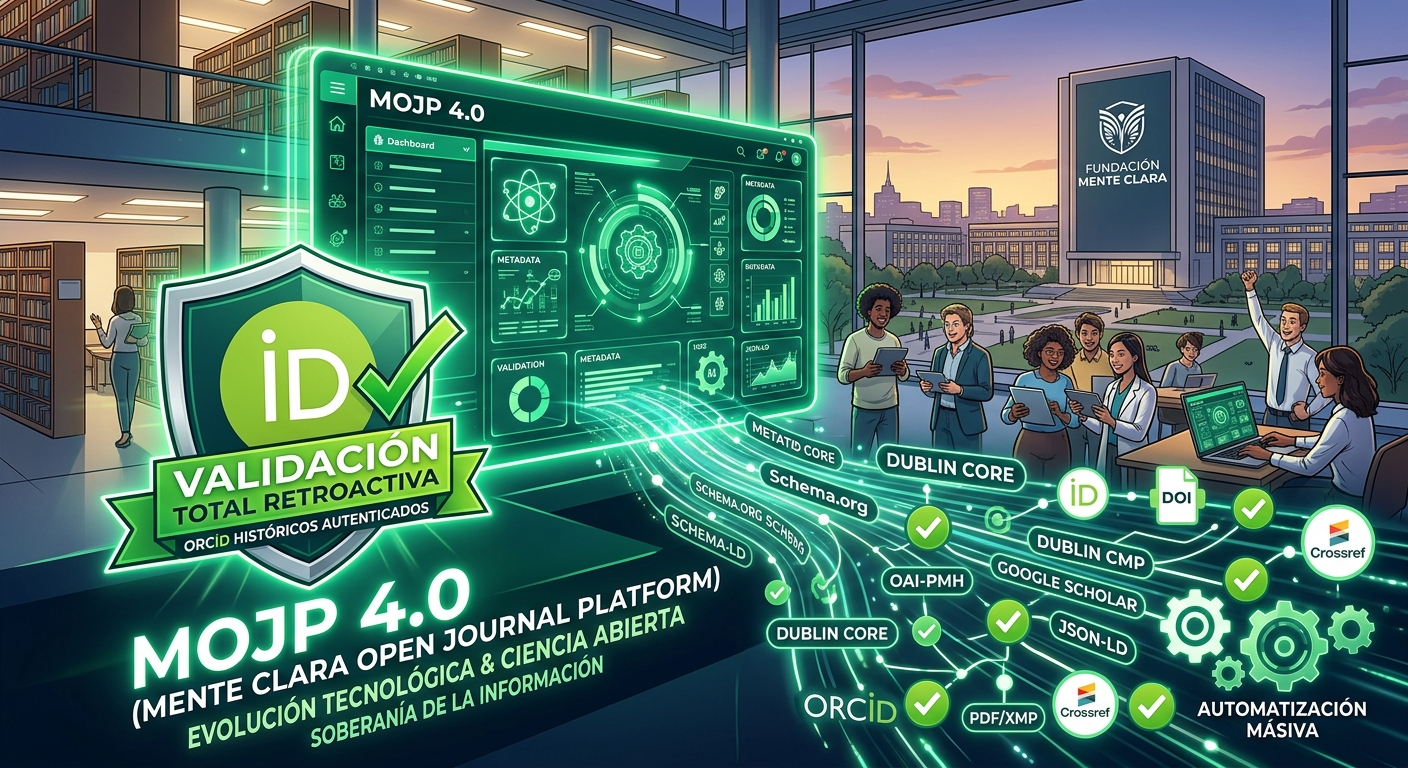
We are pleased to announce the launch of our new technological platform MOJP 4.0 (MenteClara Open Journal Platform), an integral evolution of our editorial infrastructure designed to guarantee information sovereignty, extreme performance, and maximum international visibility for our publications.
This update represents a technical and institutional milestone for Fundación Mente Clara, consolidating our position at the forefront of independent scientific publishing through engineering 100% oriented toward open science.
Main Technical Innovations of MOJP 4.0:-
Metadata Engine Rewritten for Extreme Performance: A proprietary development focused on purity and efficiency. The source code of our pages (
view-source:) is now a benchmark of web engineering designed by and for scientific research. -
Direct Reading Without Intermediaries (Zero-JS Dependency): A bot from Crossref, Dialnet, OpenAlex, Google Scholar and others, does not need to process megabytes of JavaScript or resolve cookies to index a paper. All crucial information (authors, verified ORCID, DOI, affiliations, and PDF/HTML files) is read cleanly and immediately in the first 10 Kbytes of the source file.
-
Seamless Coexistence of Semantic Schemes: Harmonious and conflict-free coexistence of the main international standards in each article:
-
Highwire Press / Google Scholar tags: (
citation_author,citation_author_orcid, etc.). -
Complete Dublin Core: (
DC.Creator,DC.Identifier.DOI). -
Schema.org (ScholarlyArticle): International-level JSON-LD format.
-
Open Graph / Twitter Cards: Guaranteeing exact and professional previews when sharing on social and academic networks.
-
-
Traceability and Persistent Identity: Direct linking to the Foundation's institutional domain (
fundacionmenteclara.org.ar), integrating global identifiers such as our ROR registry (03pssnk88) and the Crossref Funder ID (100032896). -
Zero Commercial Garbage: Complete absence of heavy trackers, advertising scripts, or third-party elements that block document parsing or endanger reader privacy. Neither traditional Diamond journals (due to a lack of development resources in standard OJS) nor commercial Gold journals costing thousands of dollars in APCs care for the technical purity of HTML in this manner.
-
Extended OAI Schema to the Maximum (Unique within the international scientific ecosystem): We developed a customized OAI schema that includes complete article references, library cataloging, cover images, disciplines, funding agencies, and metadata extended to the technical limit—a depth of indexing nonexistent in the international scientific ecosystem. You can verify this unique structure in our OAI-PMH registry.
-
XMP Metadata Injection in PDF Galleys: Upon closing the galley, each PDF file receives a complete injection of structured metadata (Dublin Core, PRISM, Crossmark, and PDFX). The document travels self-contained with all its scientific DNA to any repository in the world. You can verify this by downloading any PDF from our journal and uploading it to exif.tools to see the complexity of those metadata that allow academic search engines to find them instantly.
-
Sanitization and Mass Identity Validation (ORCID): We successfully automated the retroactive marking of ORCID records over a decade old as authenticated. While the standard OJS system leaves old profiles obsolete or "unverified" due to a lack of modern OAuth, our architecture ensures that the journal's entire historical archive maintains its green validation badge intact, ensuring seamless traceability.
With MOJP 4.0, we have resolved and overcome the rigidities and operational failures of standard OJS versions. There is no longer any need to take complex editorial courses or deal with cryptic configurations: this platform is 100% user-friendly and requires no prior technical knowledge to manage and complete all editorial processes from start to finish.
We thank our community for accompanying us in this constant pursuit of independence, agility, and academic hierarchization. We invite you to experience the speed and cleanliness of our new platform.
Website or Scientific Visibility Engine? Another Empirical TestMost journals focus solely on offering a "pretty page." However, the true impact of an article does not depend on its visual design, but on how scientific search engines and global indexers (Google Scholar, Crossref, etc.) read and interpret its data. By utilizing MOJP 4.0, the Journal of the Fundación Mente Clara matches the metadata architecture of top commercial publications such as Springer Nature and surpasses that of The Lancet. This is why our authors see their articles read and cited in prestigious international journals—including Nature Portfolio.
We invite you to verify it yourself. If you want to see the difference between MOJP 4.0 and a traditional journal:
-
Go to any of our published articles.
-
Right-click and select “View Page Source”.
-
You will find, in the first few kilobytes and without the need to execute scripts or cookies, all metadata perfectly structured, validated, and instantly indexable by the international scientific community.
Technical Comparative Analysis: MOJP 4.0 vs. The Lancet (Elsevier)
- Indexing and Page Load (Zero-JS):
- The Lancet: Complex. Relies on JavaScript frameworks, cookies, and tracking scripts. Bots must execute code to extract the document structure.
- MOJP 4.0: Pure (Zero-JS Dependency). Metadata is located within the first few KBs of the source code, eliminating the need to process JS or handle cookies.
- Persistent Identifiers Integration (ORCID / ROR / Funder ID):
- The Lancet: Standard. ORCID for active authors, but limited retroactive validation across historical articles.
- MOJP 4.0: Sanitized and Authenticated. Automated retroactive processing with intact validation (green ORCID badge), embedded institutional ROR, and Crossref Funder ID.
- Coexistence of Semantic Schemas:
- The Lancet: Highwire Press, Dublin Core, and basic Schema.org.
- MOJP 4.0: Simultaneous Multiple Schemas. Highwire Press, full Dublin Core, Schema.org (JSON-LD), and Open Graph / Twitter Cards coexisting seamlessly without namespace conflicts.
- XMP Metadata Injection in PDF Galleys:
- The Lancet: Variable depending on the publication year (many historical PDFs lack embedded XMP metadata).
- MOJP 4.0: Universal. All PDF galleys feature deep XMP metadata injection (Dublin Core, PRISM, Crossmark, and PDFX) embedded directly into the file.
- OAI-PMH Schema:
- The Lancet: Standard
oai_dc/pamstructured according to Elsevier's API. - MOJP 4.0: Extended Schema. Includes full reference lists, library cataloging, cover images, academic disciplines, and funding agencies within the OAI harvester response.
- The Lancet: Standard
Editorial Committee and Technological Administration





 View the