
TRACEMI: A PROPOSED MULTIVECTORIAL MODEL OF EDUCATIONAL MEANING-MAKING AND FEASIBLE AGENCY
TRACEMI: MODELO MULTIVECTORIAL PROPUESTO DE CONSTRUCCIÓN DE SIGNIFICADOS EDUCATIVOS Y CAPACIDAD EFECTIVA DE ACCIÓN
Mario Guadalupe López Ayala mario.lopez@uadeo.mx
Universidad Autónoma de Occidente, México.
ORCID: https://orcid.org/0000-0001-5377-6257
Israel Osuna Flores iosuna@uaim.edu.mx
Universidad Autónoma Indígena de México, México.
ORCID: https://orcid.org/0009-0001-0199-2983
Cómo citar este artículo / Citation: López Ayala, M. G. & Osuna Flores, I. (2026). TRACEMI: A Proposed Multivectorial Model of Educational Meaning-Making and Feasible Agency. Revista Científica Arbitrada de la Fundación MenteClara, Vol. 11 (471).
DOI: https://doi.org/10.32351/rca.v11.471
Copyright: © 2026 RCAFMC. Este artículo de acceso abierto es distribuido bajo los términos de la licencia Creative Commons Attribution 4.0 International License (CC BY 4.0). Recibido: 15/11/2026. Aceptado: 18/11/2026. Publicación online: 23/11/2026.
Conflicto de intereses: Ninguno que declarar.
Abstract
TRACEMI—Translation, Relational Agency, Contextual Enactment, and Mentee Interpretation—is introduced as a proposed multivectorial model for examining how educational guidance acquires meaning and becomes actionable within institutionally situated mentoring relationships. Its central question concerns the relationship among what institutions intend, what mentors enact, what mentees interpret, and which educational actions remain realistically available under evolving social conditions. The model identifies three analytical distinctions: institutional–practice divergence (D1), relational–interpretive divergence (D2), and interpretation–action discontinuity (D3). Relational agency operates through negotiation and feedback, while institutional, socioeconomic, sociocultural, territorial, environmental, and security-related conditions may shape the processes and opportunities under examination across historical, institutional, and relational time. The article adopts a combined Theory Synthesis and Model research design informed by Jaakkola (2020): existing scholarship supplies conceptual foundations, and model development specifies TRACEMI's architecture, propositions, boundaries, and empirical agenda. Evidence associated with Russia, China, England, Finland, and Mexico is organized by analytically relevant mechanisms rather than treated as comparable national observations. TRACEMI's proposed contribution resides in this specified integration and research objective, not in claiming priority over independently established concepts concerning mentoring, agency, institutional enactment, or capabilities. Four core and six contextual propositions provide a structured basis for future empirical inquiry. TRACEMI is presented as an original conceptual proposal requiring empirical investigation; no causal effects or comparative explanatory superiority are claimed.
Resumen
Este artículo presenta TRACEMI —Traducción, Agencia Relacional, Implementación Contextual e Interpretación del Estudiante— como un modelo multivectorial propuesto para investigar cómo la orientación educativa adquiere significado y puede traducirse en acciones dentro de relaciones institucionales de mentoría. El problema central consiste en distinguir lo que las instituciones pretenden, lo que los mentores realizan, lo que los estudiantes interpretan y las posibilidades reales de acción bajo condiciones sociales cambiantes. El modelo establece tres distinciones analíticas: divergencia institucional–práctica (D1), divergencia relacional–interpretativa (D2) y discontinuidad entre interpretación y acción (D3). La agencia relacional opera mediante negociación y retroalimentación, mientras que las condiciones institucionales, socioeconómicas, socioculturales, territoriales, ambientales y de seguridad pueden influir en las trayectorias educativas a través del tiempo histórico, institucional y relacional. El diseño metodológico combina síntesis teórica y construcción de modelos siguiendo a Jaakkola (2020). La evidencia de Rusia, China, Inglaterra, Finlandia y México se organiza según mecanismos pertinentes, sin asumir equivalencia nacional. La contribución propuesta reside en la integración de estas relaciones y en diez proposiciones que orientan su investigación empírica futura. TRACEMI se presenta como una propuesta conceptual original aún no validada empíricamente; no se afirman efectos causales ni superioridad explicativa demostrada.
Keywords: TRACEMI; educational mentorship; theory synthesis; conceptual model; interpretive divergence; relational agency; feasible action; spatiotemporal context; comparative education; constrained agency
Palabras Claves: TRACEMI; mentoría educativa; síntesis teórica; modelo conceptual; divergencia interpretativa; agencia relacional; acción factible; contexto espaciotemporal; educación comparada; agencia condicionada
1. Introduction
TRACEMI proposes a multivectorial explanation of educational meaning-making within mentorship. It examines how formal educational purposes move into relational practice, how those practices acquire meaning for mentees, and how circumstances affect the possibility of acting upon the guidance received. The proposed architecture connects four components—Translation, Relational Agency, Contextual Enactment, and Mentee Interpretation—with three distinct analytical comparisons: institutional–practice divergence (D1), relational–interpretive divergence (D2), and interpretation–action discontinuity (D3). Its focus is the identifiable mentoring relationship, observed within institutions and across changing social and historical conditions.
The central problem emerges because institutional expectations, mentor intentions, participant interpretations, and realized educational decisions are not interchangeable. Institutions may promote academic mobility, professional development, civic participation, or autonomy; mentors subsequently communicate and adapt these purposes through concrete encounters. A mentee can understand and endorse the guidance yet encounter financial responsibilities, limited transportation, organizational barriers, displacement, or insecurity that restrict practical alternatives. Alternatively, a mentee may freely disagree and select another pathway. The same administrative result—nonparticipation, for example—can therefore conceal different educational meanings and processes. TRACEMI specifies how these distinctions could be reconstructed without assuming that divergence automatically signals institutional failure.
The proposed contribution has three related dimensions. First, TRACEMI makes institutional purpose, enacted practice, mentor-intended meaning, mentee interpretation, feasible options, and observed action independently examinable within one analytical architecture. Second, it treats relational agency as reciprocal negotiation and feedback rather than a one-way transmission from mentor to mentee. Third, it integrates these processes with relevant contextual vectors and distinguishes historical, institutional, and relational time, thereby allowing the circumstances of interpretation and action to change at different moments. The model is intended to organize a research programme, not to prescribe an ideal mentoring practice or claim universal effects.
The scientific foundations are deliberately multidisciplinary. Research on developmental mentoring (Nuis et al., 2023; National Academies of Sciences, Engineering, and Medicine, 2019), ecological context, institutional enactment, dyadic perceptions, behavioral intention, capabilities, and realist evaluation provides concepts with which TRACEMI can be constructed and critically examined (Kram, 1985; Bronfenbrenner & Morris, 2006; Sambunjak, 2015; Braun et al., 2011; Heeneman & de Grave, 2019; Ajzen, 1991; Sen, 1999; Pawson & Tilley, 1997). These sources investigate different objects and relationships; their relevance here is the role they play in specifying TRACEMI. Their existence neither establishes duplication nor automatically proves the originality of the proposed integration.
To develop TRACEMI, the article combines Theory Synthesis and Model approaches to conceptual research following Jaakkola (2020). It first defines the model and its conceptual foundations, then elaborates its three divergences, spatial and temporal conditions, and international applicability through research associated with Russia, China, England, Finland, and Mexico. A worked illustration and ten propositions translate the architecture into questions suitable for future research. The guiding question is: How do institutional translation, contextual enactment, relational agency, and mentee interpretation jointly shape the relationship between educational guidance and feasible action under changing multivectorial conditions? The empirical programme asks how this integrated account can be observed, differentiated, and assessed.
2. Conceptual Research Design: Theory Synthesis and Model
The methodological design begins with TRACEMI as the intended conceptual product. The combined strategy developed from Jaakkola (2020) has two complementary functions: Theory Synthesis critically assembles and differentiates scientific knowledge relevant to the TRACEMI research question, while the Model approach specifies the resulting architecture, relationships, boundary conditions, and propositions. They are research-design strategies serving one original proposal, not two substantive theories being mechanically merged. The model-development function is primary; synthesis provides its justification and conceptual materials.
The synthesis is purposive, non-systematic, and organized by theoretical function. Sources were included when they defined mentoring relationships, clarified institutional translation, examined mentor–mentee meaning, distinguished intention from opportunity or action, described contextual conditions relevant to educational decisions, or provided methodological tools for assessing proposed mechanisms. The scientific literature was grouped to identify what each tradition contributes to TRACEMI—not to construct an exhaustive history of mentoring theory or establish absolute intellectual priority. Selection was based on relevance to the analytical architecture; neither a systematic database-screening protocol nor a representative multinational sample was undertaken.
The construction follows a transparent sequence: (1) delimit the institutional mentoring relationship and the phenomena TRACEMI seeks to explain; (2) identify the conceptual tools needed to distinguish intention, enactment, meaning, opportunity, and action; (3) connect these tools within the model while specifying relational feedback and temporal change; (4) derive propositions and observables that could challenge the resulting distinctions; and (5) define a feasible empirical programme. The criterion of theoretical contribution is whether this organization produces coherent, relevant, and examinable research questions, consistent with the guidance on conceptual scholarship provided by Whetten (1989), Corley and Gioia (2011), and Jaakkola (2020).
The following table identifies the role of selected theories in constructing TRACEMI. A precedent for an individual mechanism is acknowledged as scientific grounding; it is not used to make an unwarranted claim that the objective or full architecture of the earlier investigation is identical to TRACEMI.
Table 1. Theoretical resources organized around TRACEMI's conceptual architecture
|
Foundation |
Representative research |
Function within TRACEMI |
Contribution to model construction |
|
Mentorship and developmental relationships |
Kram (1985); Rhodes et al. (2006); Sambunjak (2015); National Academies (2019) |
Delimits the relationship and its developmental context |
Defines the focal unit and ecologically situated interaction |
|
Institutional translation and enactment |
Meyer and Rowan (1977); Ball et al. (2011); Braun et al. (2011) |
Grounds the distinction between formal purpose and practice |
Supports the specification of T, CE, and D1 |
|
Dyadic interpretation and learning |
Fagenson-Eland et al. (2005); Heeneman and de Grave (2019); Alonso et al. (2024); Schunk and Mullen (2013) |
Clarifies mentor–mentee accounts and reciprocal learning |
Informs MI, RA, and D2 |
|
Agency, capabilities, and time |
Ajzen (1991); Sen (1999); Elder (1998); Emirbayer and Mische (1998) |
Distinguishes intentions, actual opportunities, agency, and temporal experience |
Informs feasible options, D3, and temporal dynamics |
|
Context-dependent mechanisms |
Pawson and Tilley (1997); Suurmond et al. (2023); Rehman et al. (2026) |
Provides methodological resources for examining how context matters |
Informs explanatory propositions and empirical design |
|
Security, governance, and education in crisis |
Lessing (2021); Kim et al. (2026) |
Differentiates forms of authority and documented restrictions |
Informs contextual boundaries without equating distinct conflicts |
3. Defining the TRACEMI Architecture
At the center of TRACEMI is a specific explanatory task: reconstructing how mentoring-related educational meanings and actions emerge at the intersection of institutional purpose, relational practice, participant interpretation, and changing opportunities. Its primary unit of analysis is an identifiable mentoring relationship during a specified period; institutions and contextual conditions are analytically relevant insofar as they shape the observed relationship, not merely because they characterize a geographical setting.
Translation (T) denotes the interpretation of institutional purposes into responsibilities, decision rules, and expectations assigned to mentors. It concerns what the institution asks the mentoring relationship to accomplish and how these requirements are understood by those responsible for delivery. Contextual Enactment (CE) denotes the observable practices through which those expectations are implemented or adapted, including feedback, meetings, opportunity facilitation, and discretionary adjustments. The distinction between T and CE is essential: documents and stated responsibilities provide evidence of translation, whereas observations and contemporaneous records provide evidence of enactment. Neither constitutes sufficient evidence of the other.
Mentee Interpretation (MI) refers to the meanings a participant assigns to specific mentoring encounters, including perceived purpose, legitimacy, relevance, agreement, disagreement, or intended response. It is not synonymous with satisfaction, relationship quality, or successful learning. Relational Agency (RA) refers to the situated capacity of both parties to negotiate, question, accept, modify, or resist mentoring meanings; it is a cross-cutting property of the relationship, not a fourth step following translation, enactment, and interpretation. Mentors may adapt practice in response to feedback, and mentees may reinterpret earlier advice as circumstances evolve.
A separate analytical domain—the feasible option space—captures actions realistically available under specified resource, institutional, social, and security-related conditions. It is informed by the capability approach and theories of intention and control rather than asserted as an independently new construct. It must be distinguished from perceived opportunity, expressed intention, and observed action, each of which requires its own evidentiary basis.
Table 2. Working construct definitions and discriminant evidence
|
Domain |
Central question |
Principal evidence |
Do not infer |
|
T: Translation |
What responsibilities and purposes are assigned to the mentor? |
Policies, programme instructions, role accounts |
That prescribed activities actually occurred |
|
CE: Contextual Enactment |
What did the mentor do or adapt? |
Observation, dated contact records, feedback |
That enactment was interpreted as intended |
|
MI: Mentee Interpretation |
What meaning did the mentee construct? |
Independent interview about specific encounters |
That reported agreement produced action |
|
RA: Relational Agency |
What opportunities existed to negotiate meaning? |
Interaction episodes, feedback, decisions, perceived authority |
That compliance necessarily demonstrates autonomy |
|
Feasible option space |
Which alternatives were realistically available? |
Resources, access, requirements, constraints, perceptions |
That every unavailable action arose from coercion |
|
Observed educational action |
What did the participant actually do? |
Dated participation, decisions, trajectory records |
That action alone identifies its cause or meaning |
4. Three Divergences and the Logic of the Model
D1: Institutional–practice divergence compares stated institutional objectives and enacted mentoring practices. An observed difference may represent discretionary adaptation, resource scarcity, conflicting responsibilities, or implementation failure; the difference itself does not settle that evaluation. D1 must be reconstructed using independent evidence of institutional expectations and mentoring practice, rather than interpreting either source as a complete account of implementation.
D2: Relational–interpretive divergence compares meaning intended by the mentor with meaning constructed by the mentee regarding the same encounter. TRACEMI situates this comparison alongside D1, reciprocal negotiation, and D3, allowing disagreement, misunderstanding, and the co-construction of meaning to be examined within the same educational episode rather than inferred solely from satisfaction or participation indicators. Dyadic mentoring scholarship provides the conceptual and measurement foundations for this distinction.
D3: Interpretation–action discontinuity compares understood or intended educational action with subsequent behavior. Importantly, D3 is not defined as a difference between interpretation and the feasible option space: feasible opportunities are a possible explanation or conditioning factor for that difference. Nonparticipation may arise from changed preferences, competing obligations, unavailable resources, institutional obstacles, or coercive restrictions, and these explanations should not be conflated. In some instances no discontinuity exists because a participant rejects advice and acts consistently with that decision.
TRACEMI conceives these divergences as analytically distinct comparisons within a recursive relationship, not as an obligatory one-way causal chain. Institutional revision, mentor feedback, mentee negotiation, and changes in feasible options can shape subsequent encounters. Figure 1 therefore represents relational agency through reciprocal negotiation and feedback and distinguishes historical, institutional, and relational time. Its arrows indicate conceptual relationships proposed for investigation, not established effects.
Figure 1. Proposed TRACEMI architecture: educational meaning and feasible action.
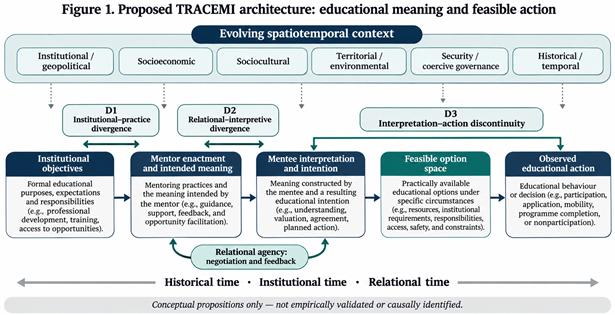
Note. The diagram distinguishes institutional objectives, mentor enactment and intended meaning, mentee interpretation and intention, feasible options, and observed educational action. D1, D2, and D3 designate comparisons between domains; feasibility may condition D3, while relational agency permits feedback. The depicted relations have not been empirically validated or causally identified. CIPRA is intentionally omitted from the diagram because it is an independent framework for appraisal of educational evidence.
5. Multivectorial Context and Temporal Boundaries
TRACEMI extends the analysis of educational meaning-making to institutional and geopolitical arrangements, socioeconomic resources, sociocultural expectations, territorial and environmental accessibility, security and coercive governance, and historical change as potentially relevant vectors. Their inclusion is conditional, not encyclopedic. A research design should select only vectors with a theoretically specified connection to the mentoring process and an observable exposure, institutional response, or participant experience. Nationality, geography, or climate alone cannot substitute for such mechanisms.
The context of a relationship may evolve at different speeds. Historical time concerns broader political, economic, demographic, or environmental developments; institutional time concerns formal programme and policy changes; and relational time concerns particular interactions and revisions in meaning. TRACEMI provisionally identifies interpretive asynchrony when relevant changes at these levels occur at distinct moments. Such asynchrony is not asserted as a validated construct; longitudinal evidence is needed to establish whether its explicit reconstruction is informative beyond established life-course and process theories (Elder, 1998; Spencer et al., 2023).
Security requires especially careful analysis. Criminal governance is not equivalent to insurgency, interstate conflict, or ordinary state regulation (Lessing, 2021), and the ERICC framework already integrates educational processes under conflict and crisis (Kim et al., 2026). TRACEMI does not seek to explain these political phenomena in general. Its question is whether specific documented restrictions affect the accessibility, interpretation, continuity, or realizability of mentoring guidance. Researchers must distinguish objective events, personally experienced exposure, perceived threat, and practical limitations, avoiding ecological fallacies (Robinson, 1950).
6. International Comparative Synthesis
TRACEMI is designed to generate comparable analytical questions across international mentoring settings without treating countries as uniform educational systems. The selected studies differ in population, intervention, institutional authority, and evidence quality. They cannot be pooled into national estimates of mentoring effectiveness, but they can inform questions about institutional direction, professional enactment, relational meaning, and opportunity.
Table 3. Mechanism-based comparison and evidentiary limits
|
Setting |
Evidence used |
Analytical contrast |
Evidence limitation |
|
Russia |
Tikhonova et al. (2024); Fominykh et al. (2026) |
Professional mentoring and broader state socialization |
Patriotic curriculum is not a mentoring intervention |
|
China |
Lee & Feng (2007); Xu et al. (2022); Li & Lu (2025); Yang & Fairbrother (2026) |
Mentor support, knowledge transfer, school inequality, institutional role expectations |
Ideological-political teacher study is adjacent policy evidence, not direct mentoring evidence |
|
England |
Hobson & Malderez (2013) |
Evaluative authority versus developmental support |
Findings concern particular school-based mentoring arrangements |
|
Finland |
Tynjälä et al. (2021) |
Peer-group reciprocity and reflective professional learning |
Collaborative mentoring differs from hierarchical dyadic programmes |
|
Mexico |
López Ayala & Osuna Flores (2026); Jarillo et al. (2016); Coria López & Pineda Castillo (2026) |
Limits of tutoring inference; constraints on educational continuity |
School-violence evidence does not demonstrate TRACEMI mechanisms |
Russian research on professional mentoring and institutional socialization is informative insofar as institutional expectations may carry professional or civic purposes, but these should not be treated as equivalent interventions. Tikhonova et al. (2024) analyze international mentoring practices and possible application within Russian education. Fominykh et al. (2026) study the influence of a Russian patriotic-education class on selected expressed political values, not the causal effects of an identifiable mentor–mentee relationship. The latter can inform questions about formal socialization aims, but not conclusions about mentoring efficacy.
Chinese mentoring studies are closer to TRACEMI's primary unit. Lee and Feng (2007) studied eight mentor–novice teacher dyads; Xu et al. (2022) investigated mentoring and tacit knowledge transfer through self-reports from 465 novice teachers; and Li and Lu (2025) examined four beginning teachers in schools differing in available resources. These provide evidence of differentiated professional learning and institutional opportunity, not a unified national mentoring model. Yang and Fairbrother (2026) add adjacent evidence about the institutional incorporation of ideological-political education teachers; their study should not be relabelled as mentoring research.
English and Finnish evidence raises questions about authority and reciprocity. Hobson and Malderez (2013) investigated evaluative practices that could constrain beginning teachers' professional growth. The Finnish review of peer-group mentoring (Tynjälä et al., 2021) describes collaborative professional learning and reflection. These studies show that agency may function differently across institutional arrangements; they do not imply that all mentoring in one country is evaluative and all mentoring in another is egalitarian.
Mexican evidence identifies inferential and contextual limits. CIPRA distinguishes the evidentiary reach of tutoring coverage, implementation, participation, results, and attribution (López Ayala & Osuna Flores, 2026). Studies of criminal violence and educational experience identify conditions potentially relevant to mobility, attendance, learning continuity, and future planning (Jarillo et al., 2016; Coria López & Pineda Castillo, 2026). Those investigations do not validate D1–D3 in mentoring. Research on cultural expectations in international STEMM mentoring (Lunsford et al., 2025), economic disadvantage and access to mentors (Raposa et al., 2018), and intergenerational guidance in conflict-affected communities (Voyvodic & Sagherian-Dickey, 2025) further clarifies potential mechanisms without establishing equivalent interventions across sites.
7. TRACEMI in Analytical Practice: An Illustrative Mentoring Case
TRACEMI's practical analytical contribution becomes clearer when an apparently identical educational outcome is reconstructed through its components. Consider a hypothetical university mentoring programme that encourages external professional placements. The institution specifies participation as a developmental objective (T), and mentors communicate the opportunities and provide guidance (CE). Two students receive similar recommendations, and administrative records eventually show nonparticipation in both cases. TRACEMI directs attention to what those records do not establish: the meaning each student constructed (MI), the possibilities for discussing alternative pathways (RA), and the options realistically available when a decision was made.
In Case A, a student understands the proposed placement but disagrees with its professional relevance and voluntarily pursues another educational pathway. In Case B, a student understands and endorses the placement yet cannot obtain necessary transport funding or considers travel unsafe in the relevant period. The observed outcome is equivalent, but Case A may involve an autonomous decision without interpretation–action discontinuity, whereas Case B may involve D3 because understood and intended action did not materialize under restricted circumstances. Neither case necessarily shows D1 or D2; those comparisons require their own evidence. The example thereby illustrates why the three divergences should not be inferred automatically from nonparticipation.
Table 4. Hypothetical TRACEMI tracing of two identical administrative outcomes
|
Dimension |
Case A: autonomous alternative |
Case B: constrained participation |
|
Institutional objective (T) |
Encourage external professional placement |
Encourage external professional placement |
|
Mentor practice (CE) |
Placement information and advice supplied |
Placement information and advice supplied |
|
Mentee interpretation (MI) |
Understands but does not endorse the opportunity |
Understands and positively values the opportunity |
|
Relational agency (RA) |
Expresses disagreement and considers alternatives |
Communicates obstacles and discusses feasibility |
|
Feasible options |
Another educational pathway is available |
Financial or security-related limits restrict travel |
|
Observed educational action |
Does not enroll in the placement |
Does not enroll in the placement |
|
Provisional TRACEMI reading |
Nonparticipation is not, by itself, D3 |
Possible D3 requiring documented evidence of restriction |
This example identifies a distinctive research use of TRACEMI: the model creates a common record linking institutional purposes, mentor practices, participant meanings, negotiation, options, and subsequent decisions within the same episode and across time. Research on mentoring and self-regulated learning (Schunk & Mullen, 2013), community mentoring (Suurmond et al., 2023), and faculty mentoring (Rehman et al., 2026) provides useful explanations and methodological insights into parts of this process. Their objectives and settings are not identical to the question posed here. TRACEMI draws on such contributions while specifying its own unit, architecture, and empirical task; the illustration is conceptual, not evidence that its explanatory value has already been validated.
8. TRACEMI's Theoretical Propositions
TRACEMI advances four core propositions that address the relationship between institutional intention, relational meaning, and feasible educational action, supported by six contextual propositions that specify circumstances in which those relationships may change. They function as research expectations rather than findings and preserve the distinction between a proposed explanatory architecture and empirically observed effects.
P1 — Differentiation of educational meaning. Independent evidence of mentor-intended meaning and mentee interpretation can reveal discrepancies that participation or fidelity measures do not identify. An empirical inquiry should determine whether the accounts differ reliably and whether this difference is already captured adequately by established relational measures.
P2 — Relative independence of D1 and D2. Correspondence between institutional objectives and enacted practices does not necessarily establish correspondence between mentor intention and mentee interpretation. Research should examine both comparisons independently rather than derive one from the other.
P3 — Interpretation and feasible action. A mentee may understand or endorse guidance yet be unable to enact the intended response under identifiable restrictions. Empirical studies should distinguish constraints from changed preferences, misunderstanding, and freely chosen alternatives.
P4 — Integrated explanatory utility. Reconstructing T, CE, MI, RA, feasible options, and observed action within a common temporal account may help distinguish educational processes that appear equivalent in administrative records. Its incremental utility requires independent evaluation through clearly specified measures and relevant theoretical alternatives.
P5 — Socioeconomic conditions. Material resources and institutional support may shape accessibility, continuity, and feasible action within mentoring relationships.
P6 — Sociocultural mediation. Expectations concerning authority, reciprocity, and communication may condition the interpretation of guidance, provided they are measured rather than inferred from nationality.
P7 — Territorial and environmental accessibility. Geographic conditions and documented disruptions may affect mentoring continuity through identifiable mechanisms.
P8 — Coercive restrictions. Personally relevant insecurity may limit educational opportunities independently of the meaning attached to advice.
P9 — Temporal differentiation. The timing and duration of exposures and institutional responses may alter the circumstances in which meanings are negotiated.
P10 — Multiple authorities. Conflicts between educational expectations and documented coercive restrictions may shape the options mentees perceive or possess; criminal, insurgent, and state authority must not be conflated.
Taken together, these propositions establish TRACEMI's research agenda. Evidence that the categories cannot be distinguished, or that the integrated model adds no useful analytical information, would warrant refinement of the proposal. This condition of criticism is part of the model's empirical development, not a reason to make earlier theories the organizing subjects of the article.
9. TRACEMI Analytical Protocol and Empirical Validation
9.1. Proposed seven-stage analytical protocol
TRACEMI is designed to guide the reconstruction of a specified mentoring episode or relationship rather than to assign automatic diagnostic labels. The following seven stages define an initial research procedure. They are proposed methodological operations, not a validated instrument; each stage requires source-specific evidence and explicit differentiation between observation, participant accounts, and interpretation.
Stage 1. Delimit the mentoring relationship and institutional purpose. Identify the institution, population, purpose, programme obligations, duration, relevant interactions, and the mentoring unit to be studied. Record the formal educational objectives without presuming that they were enacted as specified.
Stage 2. Reconstruct translation and contextual enactment (T and CE). Compare institutional directives and mentor role expectations with dated observations, meeting records, guidance, feedback, and adaptations. Record possible D1 differences and distinguish intentional adaptation from undocumented omission or resource limitations.
Stage 3. Document mentor-intended meaning and mentee interpretation (MI). Obtain independent accounts of the same mentoring encounters, ideally near the time they occurred. Identify intended and received meanings, including agreement, disagreement, misunderstanding, or negotiation, and examine whether a D2 divergence is supported by the evidence.
Stage 4. Examine relational agency (RA). Document opportunities for feedback, revision, refusal, adaptation, and reciprocal learning. Distinguish observed negotiation from mere compliance, and consider whether the mentor or mentee revised an earlier interpretation as the relationship developed.
Stage 5. Reconstruct feasible options and subsequent educational action. Specify the educational decision at issue; separately document understanding, expressed intention, realistic alternatives, constraints, and subsequent behavior. Classify a possible D3 discontinuity only where the meaning–action comparison is justified, and do not infer external restriction merely from nonparticipation.
Stage 6. Situate the episode in relevant spatial and temporal conditions. Select institutional, socioeconomic, sociocultural, territorial, environmental, or security-related vectors only where plausible mechanisms and suitable evidence exist. Distinguish documented exposure from perceived risk and reconstruct historical, institutional, and relational timing without attributing individual experiences to national averages.
Stage 7. Assess the integrated interpretation, alternatives, and uncertainty. Evaluate the evidentiary support for D1–D3, document convergent and contradictory accounts, and consider institutional, ecological, capability-based, or realist explanations where relevant. Report what the analysis clarifies, what remains uncertain, and which propositions the episode supports, qualifies, or challenges; do not describe a conceptual reconstruction as causal identification.
The protocol can be implemented through a structured record containing the episode identifier, institutional objective, documented mentoring practice, independently reported meanings, opportunities for negotiation, feasible alternatives, action observed, contextual exposure, time stamps, proposed divergence, rival interpretation, and evidence quality. Its categories should be refined through pilot coding and inter-rater reliability assessment before institutional or comparative use.
9.2. Empirical validation strategy
The first empirical stage should involve longitudinal observation of identifiable mentoring relationships, supported by institutional documentation and independently collected accounts from mentors and mentees. Evidence should refer to the same encounters where possible. Researchers would define coding criteria for T, CE, MI, RA, feasible options, and observed action; establish whether D1, D2, and D3 can be consistently distinguished; and retain observations that contradict expected relations. Temporal records would document changes in institutional mandates, specific contextual events, mentoring practices, interpretations, and practical decisions.
A subsequent study could compare institutionally equivalent programmes with different resources or authority structures. Cross-national comparisons would require explicit demonstration of intervention and measurement equivalence rather than relying on country labels. Relevant contextual indicators should be linked to participants through appropriate levels of measurement, with personal exposure and perceived restrictions distinguished from geographical averages.
A final validation stage should investigate whether TRACEMI supports a reliable reconstruction of institutional intention, mentoring practice, participant interpretation, and feasible action using common empirical material. Relevant established theories may supply complementary interpretive lenses and criteria for assessing conceptual parsimony, predictive relevance, or explanatory discrimination. TRACEMI would be strengthened by evidence that its categories remain coherent across observations and clarify differences that remain obscured in conventional administrative records; the absence of such evidence would guide revisions to the framework. None of these evaluations should be confused with causal identification.
10. CIPRA, Causal Inference, and Research Ethics
CIPRA and TRACEMI pursue different scientific objectives. CIPRA concerns what claims tutoring evidence can support across coverage, implementation, participation, observed results, and attribution (López Ayala & Osuna Flores, 2026). TRACEMI proposes an architecture for examining potential processes through which guidance is enacted, understood, and acted upon. They may be complementary, but neither framework independently identifies causal effects. Attribution requires research designs addressing relevant counterfactual assumptions, selection, and confounding (Hernán & Robins, 2020).
Context-sensitive mentoring research also entails ethical limits. Investigating violence, displacement, coercion, or informal authority can create disclosure risks. Researchers should avoid collecting identifiable information about personal routes, coercive actors, or sensitive affiliations unless necessary and adequately protected. Documentation of contexts must be sufficient for the question and proportionate to participant risk; geographic labels should never substitute for individual-level evidence or justify stigmatizing conclusions.
11. Limitations and Next Research Priorities
TRACEMI is an original conceptual proposal, not a validated general theory. The purposive synthesis does not constitute an exhaustive search of every related model, and the international sources differ in population, institutional purpose, intervention structure, and empirical method. In particular, evidence from patriotic curricula, criminal governance, school violence, or intergenerational protection cannot be treated as direct validation of mentoring-specific pathways. Contextual relevance must be established at the level appropriate to the particular relationship and decision.
These limitations delimit the next research priorities: develop transparent coding rules for the four components and three divergences; examine reciprocal agency through independent dyadic evidence; document feasible options without confusing objective constraints and perceptions; and reconstruct the timing of institutional, relational, and contextual change. Longitudinal and cross-context investigations can then assess whether the TRACEMI architecture supports coherent, reproducible explanations and identify circumstances requiring refinement. The framework is intentionally open to modification as empirical knowledge accumulates.
12. Conclusions
TRACEMI offers a proposed multivectorial architecture for investigating how institutional educational intentions acquire relational meaning and become— or fail to become—feasible educational action. Its defining analytical structure brings together Translation, Relational Agency, Contextual Enactment, and Mentee Interpretation while distinguishing institutional–practice divergence (D1), relational–interpretive divergence (D2), and interpretation–action discontinuity (D3). The model treats agency as reciprocal, contextual vectors as mechanism-dependent, and historical, institutional, and relational time as potentially asynchronous.
The article develops this proposal through a combined Theory Synthesis and Model strategy informed by Jaakkola (2020). Earlier scholarship supplies the concepts and evidence necessary to construct TRACEMI, while the integrated architecture gives them a specific research objective and organization. Its proposed originality resides in that whole configuration rather than in claims that each component is without precedent. International research provides opportunities to examine the framework across different mentoring arrangements without reducing national settings to homogeneous categories.
TRACEMI's next scientific step is empirical: determine whether its components and divergences can be observed consistently and whether the resulting analysis contributes useful knowledge about mentoring experiences and educational decisions. Until such work is completed, the framework remains a conceptually articulated proposition for study. Its central contribution is to place institutional purposes, mentoring practice, interpreted meaning, and actual educational possibilities into one explicit, temporally situated analytical account.
Research Declarations
Research type and design: Conceptual article using Theory Synthesis and Model approaches (Jaakkola, 2020); purposive, non-systematic integration of scholarship.
Empirical status: TRACEMI is introduced as a proposed framework; its constructs and propositions have not been empirically validated. No original participant-level data were collected.
Ethics: No human participants were recruited for this conceptual study; no participant-level ethics approval was sought or claimed. Future research will require review proportionate to the research setting and its risks.
Author Contribution (CRediT Statement)
According to the CRediT Contributor Roles Taxonomy, the authors declare the following contributions:
Mario Guadalupe López Ayala: Conceptualization, Methodology, Investigation, Writing – Original Draft, Writing – Review & Editing.
Israel Osuna Flores: Investigation, Validation, Writing – Review & Editing.
Both authors reviewed and approved the final version of the manuscript and assume responsibility for the integrity and academic content of the work.
References
Ajzen, I. (1991). The theory of planned behavior. Organizational Behavior and Human Decision Processes, 50(2), 179–211. https://doi.org/10.1016/0749-5978(91)90020-T
Alonso, N. A., Marshall, A., Porter, C., & Kraiger, K. (2024). Co-creating successful mentoring relationships? Investigating mentor and protégé perceptions of dyadic fit and relationship quality. Journal of Managerial Psychology, 39(6), 635–650. https://doi.org/10.1108/JMP-02-2023-0084
Ball, S. J., Maguire, M., Braun, A., & Hoskins, K. (2011). Policy actors: Doing policy work in schools. Discourse: Studies in the Cultural Politics of Education, 32(4), 625–639. https://doi.org/10.1080/01596306.2011.601565
Braun, A., Ball, S. J., Maguire, M., & Hoskins, K. (2011). Taking context seriously: Towards explaining policy enactments in the secondary school. Discourse: Studies in the Cultural Politics of Education, 32(4), 585–596. https://doi.org/10.1080/01596306.2011.601555
Bronfenbrenner, U., & Morris, P. A. (2006). The bioecological model of human development. In R. M. Lerner (Ed.), Handbook of child psychology: Vol. 1. Theoretical models of human development (6th ed., pp. 793–828). Wiley.
Coria López, P. J., & Pineda Castillo, K. A. (2026). Experiencia de estudiantes de bachillerato en tiempos de violencia en Sinaloa. Revista Construyendo Paz Latinoamericana, 11(24). https://doi.org/10.35600/25008870.2026.24.0423
Corley, K. G., & Gioia, D. A. (2011). Building theory about theory building: What constitutes a theoretical contribution? Academy of Management Review, 36(1), 12–32. https://doi.org/10.5465/amr.2009.0486
Elder, G. H., Jr. (1998). The life course as developmental theory. Child Development, 69(1), 1–12. https://doi.org/10.1111/j.1467-8624.1998.tb06128.x
Emirbayer, M., & Mische, A. (1998). What is agency? American Journal of Sociology, 103(4), 962–1023. https://doi.org/10.1086/231294
Fagenson-Eland, E. A., Baugh, S. G., & Lankau, M. J. (2005). Seeing eye to eye: A dyadic investigation of the effect of relational demography on perceptions of mentoring activities. Career Development International, 10(6/7), 460–477. https://doi.org/10.1108/13620430510620557
Fominykh, I., Kozlov, V., Romanov, D., & Rosenberg, D. (2026). Patriotic education in Russia: Will it achieve loyalty? Post-Soviet Affairs, 42(5), 575–605. https://doi.org/10.1080/1060586X.2026.2643798
Heeneman, S., & de Grave, W. (2019). Development and initial validation of a dual-purpose questionnaire capturing mentors' and mentees' perceptions and expectations of the mentoring process. BMC Medical Education, 19, Article 133. https://doi.org/10.1186/s12909-019-1574-2
Hernán, M. A., & Robins, J. M. (2020). Causal inference: What if. Chapman & Hall/CRC.
Hobson, A. J., & Malderez, A. (2013). Judgementoring and other threats to realizing the potential of school-based mentoring in teacher education. International Journal of Mentoring and Coaching in Education, 2(2), 89–108. https://doi.org/10.1108/IJMCE-03-2013-0019
Jaakkola, E. (2020). Designing conceptual articles: Four approaches. AMS Review, 10, 18–26. https://doi.org/10.1007/s13162-020-00161-0
Jarillo, B., Magaloni, B., Franco, E., & Robles, G. (2016). How the Mexican drug war affects kids and schools? Evidence on effects and mechanisms. International Journal of Educational Development, 51, 135–146. https://doi.org/10.1016/j.ijedudev.2016.05.008
Kim, H. Y., Tubbs Dolan, C., Aber, J. L., Diazgranados, S., Pherali, T., & ERICC Research Programme Consortium. (2026). A conceptual framework for education research in conflict and protracted crisis (ERICC): A holistic approach for systematic field building. Educational Researcher, 55(3), 204–211. https://doi.org/10.3102/0013189X251406243
Kram, K. E. (1985). Mentoring at work: Developmental relationships in organizational life. Scott, Foresman.
Lee, J. C.-K., & Feng, S. (2007). Mentoring support and the professional development of beginning teachers: A Chinese perspective. Mentoring & Tutoring: Partnership in Learning, 15(3), 243–262. https://doi.org/10.1080/13611260701201760
Lessing, B. (2021). Conceptualizing criminal governance. Perspectives on Politics, 19(3), 854–873. https://doi.org/10.1017/S1537592720001243
Li, X., & Lu, L. (2025). School quality matters: How mentoring can be restructured to support beginning teachers in different schools from a social capital perspective. Research Papers in Education, 40(2), 213–235. https://doi.org/10.1080/02671522.2024.2368496
López Ayala, M. G., & Osuna Flores, I. (2026). Tutorías universitarias en México: alcances y límites de la evidencia para atribuir efectos educativos. Una revisión integrativa crítica desde el marco CIPRA. Revista Científica Arbitrada de la Fundación MenteClara, 11, 455. https://doi.org/10.32351/rca.v11.455
Lunsford, L. G., Luo, L., & Stoeger, H. (2025). The influence of national culture on the initiation of mentoring in a STEMM talent development program: Mentors' perspectives. Humanities and Social Sciences Communications, 12, Article 1352. https://doi.org/10.1057/s41599-025-05072-8
Meyer, J. W., & Rowan, B. (1977). Institutionalized organizations: Formal structure as myth and ceremony. American Journal of Sociology, 83(2), 340–363. https://doi.org/10.1086/226550
National Academies of Sciences, Engineering, and Medicine. (2019). The science of effective mentorship in STEMM. The National Academies Press. https://doi.org/10.17226/25568
Nuis, W., Segers, M., & Beausaert, S. (2023). Conceptualizing mentoring in higher education: A systematic literature review. Educational Research Review, 41, Article 100565. https://doi.org/10.1016/j.edurev.2023.100565
Pawson, R., & Tilley, N. (1997). Realistic evaluation. SAGE Publications.
Raposa, E. B., Erickson, L. D., Hagler, M., & Rhodes, J. E. (2018). How economic disadvantage affects the availability and nature of mentoring relationships during the transition to adulthood. American Journal of Community Psychology, 61(1–2), 191–203. https://doi.org/10.1002/ajcp.12228
Rehman, R., Javaid, Q., Khalid, S., Ali, T. S., & Ali, R. (2026). Applying the realist evaluation framework to a faculty mentorship program: A context–mechanism–outcome analysis at a private medical university. BMC Medical Education, 26, Article 287. https://doi.org/10.1186/s12909-025-08458-z
Rhodes, J. E., Spencer, R., Keller, T. E., Liang, B., & Noam, G. (2006). A model for the influence of mentoring relationships on youth development. Journal of Community Psychology, 34(6), 691–707. https://doi.org/10.1002/jcop.20124
Robinson, W. S. (1950). Ecological correlations and the behavior of individuals. American Sociological Review, 15(3), 351–357. https://doi.org/10.2307/2087176
Sambunjak, D. (2015). Understanding wider environmental influences on mentoring: Towards an ecological model of mentoring in academic medicine. Acta Medica Academica, 44(1), 47–57. https://doi.org/10.5644/ama2006-124.126
Schunk, D. H., & Mullen, C. A. (2013). Toward a conceptual model of mentoring research: Integration with self-regulated learning. Educational Psychology Review, 25(3), 361–389. https://doi.org/10.1007/s10648-013-9233-3
Sen, A. (1999). Development as Freedom. Alfred A. Knopf.
Spencer, R., Drew, A. L., & Gowdy, G. (2023). Going the distance: A longitudinal qualitative study of formal youth mentoring relationship development. Journal of Community Psychology, 51(8), 3083–3102. https://doi.org/10.1002/jcop.23006
Suurmond, J., Kruithof, K., & Harting, J. (2023). Does mentoring improve the health of people in the community? A realist evaluation. Journal of Social Work, 23(3), 463–484. https://doi.org/10.1177/14680173221144411
Tikhonova, N. V., Ratner, F. L., & Vergasova, I. Y. (2024). Mentoring in education: An analysis of international practices and their implementation in Russia. The Education and Science Journal, 26(5), 124–151. https://doi.org/10.17853/1994-5639-2024-5-124-151
Tynjälä, P., Pennanen, M., Markkanen, I., & Heikkinen, H. L. T. (2021). Finnish model of peer-group mentoring: Review of research. Annals of the New York Academy of Sciences, 1483(1), 208–223. https://doi.org/10.1111/nyas.14296
Voyvodic, C., & Sagherian-Dickey, T. (2025). Raising children under fire: Civilian agency and intergenerational transmission in Colombia, Northern Ireland and Lebanon. Cooperation and Conflict. Advance online publication. https://doi.org/10.1177/00108367251348108
Whetten, D. A. (1989). What constitutes a theoretical contribution? Academy of Management Review, 14(4), 490–495. https://doi.org/10.5465/amr.1989.4308371
Xu, J., Wei, X., Hisrich, R. D., Yu, M., & Li, X. (2022). Mentoring and tacit knowledge transfer in novice teachers from Chinese middle schools: Mediating effect of job crafting. Frontiers in Education, 7, Article 772638. https://doi.org/10.3389/feduc.2022.772638
Yang, H., & Fairbrother, G. P. (2026). State legitimation and its incorporation of ideological-political education teachers in China, 1979–2023. Journal of Contemporary China. Advance online publication. https://doi.org/10.1080/10670564.2026.2740552