
THE SOCIALLY DISCONNECTED KNOWLEDGE PARADOX: AGENTIC SCIENCE, POWER, CRIMINAL GOVERNANCE, AND SOCIETAL VALUE
LA PARADOJA DEL CONOCIMIENTO SOCIALMENTE DESCONECTADO: CIENCIA AGÉNTICA, PODER, GOBERNANZA CRIMINAL Y VALOR SOCIAL
Mario Guadalupe López Ayala mario.lopez@uadeo.mx
Universidad Autónoma de Occidente, México.
ORCID: https://orcid.org/0000-0001-5377-6257
Israel Osuna Flores iosuna@uaim.edu.mx
Universidad Autónoma Indígena de México, México.
ORCID: https://orcid.org/0009-0001-0199-2983
Cómo citar este artículo / Citation: López Ayala, M. G. & Osuna Flores, I. (2026). The Socially Disconnected Knowledge Paradox: Agentic Science, Power, Criminal Governance, and Societal Value. Revista Científica Arbitrada de la Fundación MenteClara, Vol. 11 (462).
DOI: https://doi.org/10.32351/rca.v11.462
Copyright: © 2026 RCAFMC. Este artículo de acceso abierto es distribuido bajo los términos de la licencia Creative Commons Attribution 4.0 International License (CC BY 4.0). Recibido: 02/11/2026. Aceptado: 07/11/2026. Publicación online: 11/11/2026.
Conflicto de intereses: Ninguno que declarar.
Abstract
The expansion of agentic artificial intelligence is transforming scientific discovery, yet growing scientific capabilities do not necessarily yield corresponding improvements in societal well-being. This article develops the Socially Disconnected Knowledge Paradox (SDKP) as a conceptual framework examining how the application and societal value of scientific knowledge depend on policy authority, legal entitlement, effective operational control, and institutional capacity. Integrating innovation studies, institutional economics, science policy, research impact assessment, and criminal-governance scholarship, SDKP introduces authority–control–value disconnection as its central construct. It distinguishes implementation disconnection, in which governance or resource constraints impede the use of scientifically supported knowledge, from distributional disconnection, in which an effective application does not deliver its intended breadth of benefits because of identifiable access or appropriation arrangements. The article formulates six conditional propositions, proposes an analytical protocol, and identifies directions for comparative research. Organized criminal interference is included only when evidence establishes its relevance to a particular scientific application. The proposed distinctions are conceptual and require independent empirical assessment.
Resumen
La expansión de la inteligencia artificial agéntica está transformando el descubrimiento científico, pero el aumento de las capacidades científicas no necesariamente genera mejoras equivalentes en el bienestar social. Este artículo desarrolla la Paradoja del Conocimiento Socialmente Desconectado (SDKP) como un marco conceptual para examinar cómo la aplicación y el valor social del conocimiento científico dependen de la autoridad pública, la titularidad jurídica, el control operativo efectivo y la capacidad institucional. A partir de los estudios de innovación, la economía institucional, la política científica, la evaluación del impacto de la investigación y la literatura sobre gobernanza criminal, el modelo introduce la desconexión entre autoridad, control y valor como constructo central. Distingue la desconexión de implementación, que dificulta la utilización del conocimiento científicamente sustentado, de la desconexión distributiva, que limita el alcance de los beneficios de una aplicación operativa mediante condiciones identificables de acceso o apropiación. El artículo formula seis proposiciones condicionales, propone un protocolo analítico y define una agenda de investigación comparativa. La interferencia criminal se incorpora únicamente cuando existe evidencia de su relevancia para una aplicación específica. Las distinciones propuestas son conceptuales y requieren evaluación empírica independiente.
Keywords: Socially Disconnected Knowledge Paradox; agentic artificial intelligence; scientific knowledge; authority–control–value disconnection; criminal governance; societal value
Palabras Claves: paradoja del conocimiento socialmente desconectado; inteligencia artificial agéntica; conocimiento científico; autoridad y control; gobernanza criminal; valor social
1. Introduction
Scientific knowledge has historically contributed to technological development, economic transformation, institutional modernization, and advances in human well-being. Yet the relationship between scientific discoveries and societal benefits is neither automatic nor uniform. The existence of scientifically supported findings does not establish that relevant institutions possess the resources necessary to apply them, that public policies facilitate their implementation, or that resulting economic and social benefits reach intended populations. Scientific development occurs within historically differentiated environments where political authority, economic resources, institutional capacities, cultural practices, technological infrastructure, and international relationships influence both the production and utilization of knowledge.
The increasing incorporation of artificial intelligence into scientific research introduces new possibilities for transforming these relationships. AI agents and multi-agent scientific systems can coordinate literature retrieval, hypothesis generation, computational analysis, experimental planning, and the execution of selected research methods. Ghareeb et al. (2026) demonstrated an approach to semi-autonomous scientific discovery through the coordination of specialized agents, while Miao et al. (2026) showed how research publications and associated computational resources can be converted into interactive scientific agents. Feng et al. (2026) further examined architectures in which task decomposition, memory, tool use, agent communication, and human oversight support increasingly sophisticated scientific workflows. These advances may reduce barriers to scientific participation and facilitate the reutilization of research methods, but they also introduce questions concerning epistemic reliability, control over technological infrastructure, institutional responsibility, and the conditions governing practical application.
The implications of artificial intelligence for scientific development are not uniform across research environments. Bianchini, Müller, and Pelletier (2025) identified the importance of collaboration networks, institutional characteristics, and scientific fields in the adoption of AI tools. Bianchini et al. (2026), examining more than 170 scientific fields, reported positive associations between AI-related research, scientific novelty, and impact, together with substantial differences across disciplines. Such findings demonstrate that scientific progress cannot be adequately understood through a single measure of computational capability or publication productivity. They also reinforce the distinction between improving scientific activities and establishing effective applications capable of producing identifiable societal outcomes.
Scientific utilization is equally influenced by political and economic arrangements. Public authorities determine research priorities, finance scientific infrastructure, establish regulatory conditions, facilitate international cooperation, and procure applications intended to address collective needs. Private enterprises may contribute capital, specialized knowledge, manufacturing capabilities, technological platforms, and distribution networks. However, the actors financing scientific research, possessing legal rights over its results, operating the infrastructure necessary for implementation, and receiving subsequent returns are not necessarily identical. Lazonick and Mazzucato (2013) established the importance of distinguishing who assumes innovation risks from who receives resulting rewards, while Laplane and Mazzucato (2020) examined how public–private arrangements influence these relationships.
An additional consideration emerges when the actual exercise of power differs from formal institutional authority. Organized criminal networks may affect territorial governance, investment conditions, public procurement, enterprise decisions, and the allocation of resources through distinct mechanisms of coercion, corruption, extortion, or institutional infiltration. Lessing (2021) developed a conceptual account of criminal governance, while Di Cataldo and Mastrorocco (2022) documented how organized criminal infiltration could alter municipal public expenditure in southern Italy. Zhang and Wei (2026), analyzing 92,318 enterprises across 111 countries, identified a negative relationship between organized crime and firm innovation, conditioned by organizational characteristics. These findings demonstrate the relevance of criminal interference to particular economic and institutional processes, without establishing that such interference affects all societies or scientific applications in the same manner.
The relationship among scientific development, institutional authority, private appropriation, and criminal interference raises a broader question concerning the governance of knowledge. A discovery may be scientifically valid and technologically applicable without the institution that developed it possessing effective control over its implementation. A government may authorize a scientifically justified program while depending on other organizations for infrastructure, financing, or territorial delivery. A private enterprise may legitimately commercialize a research-based technology while social outcomes depend on affordability, accessibility, public policy, and complementary institutional capabilities. In environments where criminal organizations exercise documented influence, additional constraints may emerge that are not adequately represented by formal legal or administrative arrangements alone.
The Socially Disconnected Knowledge Paradox (SDKP) examines how scientific capability, policy authority, legal entitlement, effective operational control, and societal value interact within particular knowledge-based applications. The framework distinguishes two potential disconnections: constraints that prevent scientifically supported knowledge from becoming operationally useful and arrangements that influence who benefits from applications that do function. This distinction focuses the model on mechanisms rather than treating distributed authority itself as evidence of social disconnection.
The central research question is: How do agentic scientific capabilities interact with historical, geopolitical, sociocultural, economic, institutional, and criminal-governance conditions to determine how scientific knowledge is authorized, controlled, utilized, and translated into societal value?
The article develops SDKP as a conceptual framework, establishes a structured analytical pathway, formulates six conditional propositions, and outlines its application to public-policy evaluation and international research. Its intention is to offer a scientifically examinable perspective that researchers, institutions, policymakers, enterprises, and affected communities can debate, apply, refine, or challenge.
2. Research Methodology and Conceptual Foundations
2.1. Research design
The study adopts a conceptual model-development approach informed by Jaakkola (2020), who identifies distinct strategies for developing scientific contributions through theory synthesis, adaptation, typology, and conceptual model construction. SDKP is developed through integrative theoretical reasoning intended to clarify relationships among scientific knowledge, socio-technical conditions, public authority, economic control, and societal outcomes. The objective is to formulate a coherent analytical structure and derive propositions capable of subsequent examination rather than report original statistical estimates.
The theoretical foundation draws on institutional economics, innovation studies, socio-technical transitions, absorptive capacity, science policy, political economy, organized crime, and contemporary research on artificial intelligence agents. Additional perspectives concerning technological appropriation, polycentric authority, geopolitical network power, and research impact inform the proposed mechanisms (Teece, 1986; Zahra & George, 2002; Ostrom, 2010; Farrell & Newman, 2019; Spaapen & van Drooge, 2011). These traditions provide established explanations of several mechanisms incorporated into SDKP. Their use is necessary to ground the conceptual argument and avoid confusing interdisciplinary integration with the discovery of previously unknown phenomena.
The literature was selected through a targeted, relevance-driven synthesis of foundational and contemporary publications. This approach supports conceptual development but does not constitute a completed systematic review. The study consequently does not claim exhaustive coverage of all comparable frameworks or definitive proof of theoretical uniqueness.
2.2. Analytical scope
The proposed model distinguishes three interacting levels of analysis. At the macro level, it examines societal structures, international relationships, historical trajectories, economic systems, and public institutions. At the meso level, it considers universities, laboratories, government agencies, enterprises, technological providers, and research networks. At the micro level, it examines researchers, AI agents, professional users, affected communities, and the interactions through which scientific knowledge is interpreted or applied.
These analytical levels should not be confused with the specific categories used in socio-technical transition theory. Their purpose is to distinguish societal, organizational, and operational relationships while recognizing that influence may occur in multiple directions.
The principal unit of analysis is a knowledge–governance–application–beneficiary episode, defined as an identifiable scientific or technological application involving relevant evidence, actors, governing arrangements, implementation conditions, and intended or observed outcomes.
This unit allows SDKP to investigate specific relationships without attributing the behavior of an institution or enterprise to generalized assumptions about an entire country or culture.
2.3. Scientific and normative boundaries
The framework distinguishes scientific validity, institutional feasibility, economic outcomes, and normative judgments. A scientifically justified application does not necessarily represent the preferred use of public resources. Likewise, an economically profitable innovation does not automatically produce widespread public benefits, although commercial returns and societal value may coexist.
The model also distinguishes legal private appropriation, undesirable concentration, and illicit capture. These are not interchangeable conditions. Their evaluation requires explicit evidence concerning applicable rights, economic arrangements, coercive behavior, institutional responsibilities, and observed outcomes.
Fundamental scientific research without a specified application or immediate beneficiary remains valuable and should not be classified as socially disconnected simply because no short-term economic or social return can be demonstrated.
3. Scientific Knowledge Within Historical and Societal Structures
3.1. Historical trajectories and institutional development
Scientific capabilities emerge through cumulative processes involving education, industrial learning, institutional development, research investment, and technological adaptation. North (1990) demonstrated that institutions structure incentives and influence economic development through historical processes of persistence and change. Geels (2002) established that technological transformations involve relationships among infrastructures, regulations, industrial networks, cultural meanings, and practices of technology users. Jasanoff (2004) further examined the mutual constitution of scientific knowledge and social order.
These contributions establish that the scientific capacity of an institution cannot be interpreted independently of the environment in which it developed. Universities, enterprises, and public research organizations inherit organizational routines, material capabilities, professional practices, and relationships with other institutions. Such conditions may facilitate scientific transformation or create requirements that new technologies alone cannot satisfy.
SDKP treats historical trajectories as explanatory conditions rather than determinants of unavoidable outcomes. Societies can modify inherited limitations through institutional reform, collaboration, education, investment, and technological adaptation. The scientific task is to identify which historical mechanisms remain consequential within a particular knowledge-application episode.
3.2. Geopolitical access and scientific interdependence
The international scientific system is characterized by differences in research infrastructure, technological resources, financial capacity, institutional relationships, and access to specialized expertise. Scientific knowledge may circulate internationally through publications and collaborations, while effective implementation may depend on computing services, proprietary datasets, specialized laboratory equipment, contractual arrangements, or technological components.
The World Bank (2025) identifies connectivity, computing capacity, locally relevant data, and competencies as foundational conditions influencing the adoption and adaptation of artificial intelligence. These conditions are not identical across countries or institutions, nor do they necessarily require complete domestic ownership of every technological resource.
A research institution may benefit from international platforms and partnerships, while another may encounter barriers associated with costs, service continuity, technical requirements, or restricted access. SDKP therefore examines geopolitical influence through identifiable dependencies and alternative arrangements rather than assuming that external technological participation necessarily compromises scientific autonomy.
3.3. Sociocultural interpretation and local knowledge
Scientific discoveries and computational recommendations may require adaptation to different linguistic, professional, institutional, and community environments. Their implementation can depend on the relevance of underlying data, local practices, stakeholder participation, and the compatibility of proposed applications with legitimate user requirements.
The cultural dimension should not be reduced to generalized claims about national values. Relevant evidence may concern linguistic accessibility, locally developed knowledge, professional routines, participation in scientific decisions, or the meanings assigned to particular technologies.
Within SDKP, sociocultural context is not simply a barrier to technology adoption. It may be a source of expertise that improves scientific questions, strengthens contextual interpretation, or reveals assumptions inadequately represented within computational systems.
3.4. Economic structures and technological specialization
Economic organization influences the resources available for scientific development and the conditions under which applications become financially sustainable. Enterprise size, market concentration, industrial specialization, public investment, competitive arrangements, and access to complementary assets may modify innovation outcomes.
The significance of these factors also varies across scientific disciplines. Some activities require specialized infrastructure and extensive experimentation, whereas others may benefit substantially from accessible computational services. Consequently, SDKP does not assume that technological capability produces identical economic effects across different fields, institutions, or territories.
The framework instead examines how economic and technological arrangements influence the transition from scientifically supported knowledge to operational utilization and the subsequent allocation of benefits.
4. Agentic Science and the Transformation of Scientific Authority
4.1. Scientific agents and multi-agent systems
AI agents are computational systems capable of pursuing specified objectives through combinations of information processing, tool use, decision selection, and action execution under defined permissions. Multi-agent architectures coordinate several such components, potentially assigning specialized functions involving research retrieval, analytical procedures, hypothesis development, or experimental evaluation.
Their degrees of autonomy differ. Some systems operate under continuous human supervision, while others execute defined sequences before requiring additional authorization. These architectures do not eliminate the need for scientific judgment, methodological evaluation, institutional responsibility, or ethical oversight.
Feng et al. (2026) identify important challenges involving reliability, reproducibility, interpretability, tool misuse, and the organization of human–AI scientific workflows. Miao et al. (2026) demonstrate the potential for transforming published computational methods into reusable agents, while recognizing that successful execution does not automatically establish scientific validity beyond the demonstrated scope of the original method.
4.2. Epistemic continuity
A scientific finding may undergo several transformations before becoming an application. Its original evidence may be summarized, interpreted, modeled, combined with other findings, implemented computationally, and adapted to a different organizational environment.
Each transformation may preserve, clarify, weaken, or alter the assumptions supporting the relevant scientific claim. Consequently, recording the origin of a statement is not equivalent to demonstrating that the statement remains scientifically justified after successive transformations.
International guidance on AI ethics and governance highlights related questions of transparency, oversight, and institutional accountability (United Nations Educational, Scientific and Cultural Organization [UNESCO], 2021; World Health Organization, 2021). SDKP incorporates epistemic continuity as the requirement to examine whether the evidence supporting a scientific result remains adequate for its transformed interpretation and intended application. This concept draws on established research concerning reproducibility and transferability; it is not presented as a newly discovered principle.
Its relevance to agentic science concerns the possibility that transformations occur through multiple automated components, making explicit documentation of assumptions and responsibilities particularly important.
4.3. Authority and control within agentic systems
Scientific autonomy raises questions extending beyond technical performance. A university may develop an original method, while an external organization controls the computing infrastructure through which it operates. Another enterprise may possess rights over the software used to commercialize the application, and a government may determine whether its outcomes can be incorporated into public services.
These arrangements create different forms of authority: the authority to establish scientific claims, authorize institutional decisions, license technologies, operate systems, and determine access to resulting applications.
The model's central insight is that these forms of authority should be examined separately rather than presumed to belong to the organization responsible for the original scientific discovery.
5. Power, Public Policy, and Knowledge Appropriation
5.1. Scientific development and public-policy authority
Scientific discoveries can influence public policy at international, national, regional, and municipal levels. Governments and international institutions may support research cooperation, establish technical standards, finance infrastructure, regulate technological applications, develop industrial policies, or implement services based on scientific findings.
However, scientific evidence does not independently establish legal authority or administrative capacity. Policy implementation may involve several organizations with different responsibilities, incentives, resources, and accountability arrangements.
SDKP therefore examines policy translation as the relationship between a scientifically supported application, the decisions authorizing its use, and the institutions responsible for implementation.
An intervention can possess strong scientific justification while encountering limitations in financing, coordination, regulatory authorization, or administrative capacity. Conversely, appropriate cooperation among jurisdictions may expand its feasibility and reach.
5.2. Public investment and private participation
Scientific development often involves contributions from public institutions, private enterprises, and collaborative arrangements. Public investment may support basic research, scientific infrastructure, education, or technologies later commercialized by private actors. Enterprises may contribute essential financing, expertise, manufacturing, and distribution.
Lazonick and Mazzucato (2013) established the importance of examining how innovation risks and rewards are distributed, while Laplane and Mazzucato (2020) analyzed the institutional arrangements influencing public–private returns.
SDKP incorporates this problem through a distinction between the creation of knowledge, the creation of economic value, and the appropriation or distribution of resulting benefits.
These processes are related but not equivalent. A profitable technological application may provide broad public benefits, while a publicly financed project may produce limited measurable outcomes. The relevant conclusions depend on documented institutional arrangements, costs, beneficiaries, access conditions, and observed consequences.
5.3. Legal ownership and effective operational control
The distinction between legal entitlement and practical control is central to the proposed SDKP architecture.
Legal ownership may concern patents, copyrights, licenses, contractual rights, or other protected assets. Effective operational control concerns the practical ability to access, modify, operate, distribute, maintain, restrict, or discontinue a technological application.
A university may own research results but depend on external computing services to use them. A government may finance a technology while an enterprise controls its software or service infrastructure. A research consortium may share scientific findings while participating organizations possess different rights to their commercialization.
These arrangements are not inherently problematic. Their significance depends on the flexibility of contractual conditions, the availability of substitutes, the costs of access, the distribution of risks, and the consequences for intended beneficiaries.
SDKP proposes that the relationship between legal ownership and operational control should be made explicit whenever scientific applications are evaluated for their expected societal benefits.
6. Criminal Governance as a Conditional Influence on Scientific Value
6.1. Organized crime within institutional and economic environments
Organized crime may operate through different illicit markets, economic arrangements, and relationships with legitimate institutions. Transnational drug trafficking represents an important component, but it should not be treated as synonymous with all criminal activity.
In certain settings, criminal organizations may exercise coercion, influence territorial activities, distort public decisions, or interfere with legitimate enterprise operations. Lessing (2021) provides a conceptual foundation for analyzing criminal governance, while Di Cataldo and Mastrorocco (2022) document the consequences of criminal infiltration for municipal resource allocation. Zhang and Wei (2026) provide evidence that organized crime is associated with differences in enterprise innovation.
These studies justify investigating criminal interference as an institutional and economic condition. They do not demonstrate that criminal organizations systematically control scientific discoveries or agentic research systems.
6.2. Four possible mechanisms
Within SDKP, criminal interference may become relevant through four analytically distinct pathways.
Institutional interference concerns situations in which documented criminal influence modifies public decisions, procurement, allocation of resources, or program implementation.
Economic coercion concerns circumstances in which extortion, violence, or other illicit pressures affect the costs, incentives, continuity, or viability of legitimate activities.
Territorial interference concerns conditions under which criminal organizations exercise effective influence over activities or access within particular geographical environments.
Illicit financial or commercial involvement concerns documented relationships between criminal proceeds or activities and legitimate economic operations relevant to a scientific application.
These pathways must be established through appropriate evidence. The existence of organized crime within a country does not demonstrate that a particular scientific institution or public program is affected.
6.3. Institutional resilience
The consequences of criminal interference may depend on the capacity of legitimate institutions to preserve accountability, enforce applicable rules, protect operations, and maintain public-service continuity.
Institutional resilience may involve procurement controls, independent oversight, legal enforcement, organizational safeguards, reliable contractual arrangements, and the ability to detect or respond to interference.
The relationship is not assumed to be uniform. Different forms of criminal activity may affect institutions through different mechanisms, while effective institutional responses may reduce, alter, or prevent their consequences.
SDKP therefore treats criminal governance and institutional resilience as conditional influences that should be examined within specific scientific and territorial episodes rather than assigned as generalized characteristics of entire societies.
7. The Central SDKP Contribution: Authority–Control–Value Disconnection
SDKP distinguishes scientific capability, public-policy authority, legal entitlement, effective operational control, and societal value realization. Their explanatory relevance lies in the relationships connecting valid knowledge with implementation and, subsequently, with the accessibility and distribution of benefits.
These conditions may be distributed among universities, governments, enterprises, research networks, and technology providers. Such separation can support specialization and wider access. It becomes analytically consequential only when evidence links a particular governance or control arrangement to an implementation constraint or an identifiable beneficiary outcome.
The central construct, authority–control–value disconnection, denotes a potentially consequential misalignment among the capacities and arrangements required to transform scientifically supported knowledge into operational applications and intended societal benefits. It is evaluated within a defined knowledge–governance–application–beneficiary episode.
SDKP separates the process into two mechanisms: implementation disconnection and distributional disconnection. This distinction prevents unsuccessful deployment from being conflated with limited benefit distribution after successful deployment.
7.1. Two Distinct Mechanisms of Authority–Control–Value Disconnection
Implementation disconnection occurs when scientifically supported knowledge cannot be deployed effectively, or its use is materially delayed or constrained, because indispensable authorization, resources, or implementation capabilities are unavailable or incompatible. Investigators must document how the identified arrangement affects deployment and consider alternatives such as scientific uncertainty, technical infeasibility, lack of demand, or insufficient financing.
Distributional disconnection occurs when an application is operationally effective, but specific access, entitlement, control, or appropriation arrangements materially affect who receives its intended benefits or bears its costs. Uneven outcomes alone do not establish the mechanism: the analysis must identify intended beneficiaries, document the relevant arrangement, and assess competing explanations.
The mechanisms can occur separately, jointly, or not at all. Their distinction allows SDKP to examine both the failure to transform scientific capability into effective application and the unequal realization of value from a functioning application. Figure 1 illustrates their placement in the proposed analytical architecture.
Figure 1. Integrated Explanatory Architecture of the Socially Disconnected Knowledge Paradox (SDKP)
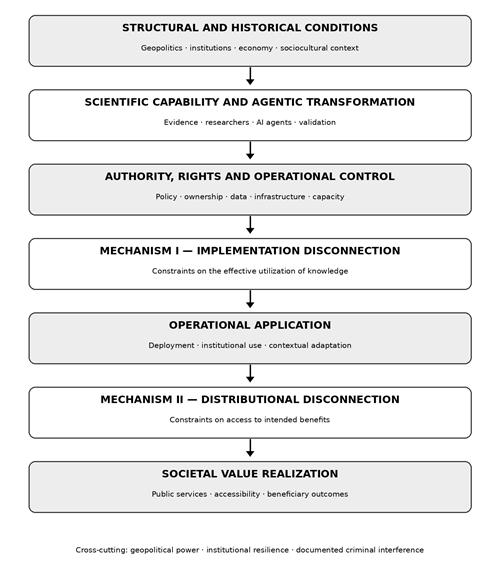
Note. Author’s
own elaboration. Conceptual relationships are non-deterministic.
The distinctions represented in Figure 1 are specified in Table 1. The table identifies the five analytical conditions, the questions associated with each, and the evidence potentially relevant to their examination. These categories support conceptual analysis rather than constitute a validated measurement scale.
Table 1. The five analytical distinctions of SDKP
|
Condition |
Central question |
Relevant evidence |
|
Scientific capability |
What knowledge or method is scientifically justified? |
Research findings, methodological quality, uncertainty, validation |
|
Policy authority |
Who can legally authorize or finance its use? |
Public mandates, regulations, financing, institutional responsibilities |
|
Legal entitlement |
Who possesses rights over the relevant application or assets? |
Patents, licenses, contracts, data rights |
|
Effective control |
Who can practically operate, modify, restrict, or distribute the application? |
Infrastructure, platforms, technical dependencies, access arrangements |
|
Societal value |
Who receives which benefits or costs, under what conditions? |
Implementation results, access, economic returns, social outcomes |
Note. Author’s own elaboration. The classification is descriptive and has not been independently validated.
SDKP integrates insights from organizational learning, innovation appropriation, public governance, network power, societal impact, and criminal governance. Table 2 clarifies that integration without claiming that any one component is individually unprecedented.
Table 2. Theoretical Foundations and Analytical Emphasis of SDKP
|
Research contribution |
Established explanation |
SDKP analytical emphasis |
|
Cohen & Levinthal (1990); Zahra & George (2002) |
Absorptive capacity |
Knowledge utilization and governance |
|
Teece (1986) |
Complementary assets |
Operational control and societal access |
|
Ostrom (2010) |
Polycentric governance |
Coordination of institutional authority |
|
Farrell & Newman (2019) |
Network asymmetries |
Dependencies affecting implementation |
|
Spaapen & van Drooge (2011); Sørensen et al. (2026) |
Research impact pathways |
Implementation versus benefit distribution |
|
Lessing (2021) |
Criminal governance |
Conditional influence of illicit power |
8. Theoretical Propositions
Proposition 1. Scientific capability and societal value are conditionally distinct
Improvements in scientific capability or agentic research performance will not necessarily produce proportional improvements in beneficiary outcomes when implementation resources, governance arrangements, or access conditions remain consequential.
This proposition permits both successful and unsuccessful transitions from scientific advances to practical benefits. It would be weakened within a defined application if the proposed intermediate conditions were irrelevant or if established alternative explanations accounted fully for the outcomes.
Proposition 2. Public-policy coordination conditions implementation
Where a scientific application depends on multiple jurisdictions or public organizations, the relationship between available scientific knowledge and effective utilization may be influenced by the alignment of institutional responsibilities, financing, regulatory authority, and implementation capacity.
The proposition applies only where such coordination is actually necessary. It would be weakened if these arrangements contributed no meaningful explanatory information to the relevant outcomes.
Proposition 3. Operational control can modify the value of scientific ownership
Where legal rights over a scientific application and effective control over its technological infrastructure are distributed among different actors, contractual conditions, alternative providers, and governance arrangements may influence implementation opportunities and the distribution of economic or social benefits.
The proposition does not presume that decentralized ownership or external technological services necessarily reduce public value. It would be weakened where the distinction between legal and operational control proved immaterial in the defined episode.
Proposition 4. Historical and sociocultural conditions influence contextual utilization
The appropriateness and effectiveness of transferring an agentically transformed scientific method to a new institutional or societal environment may depend on historically developed capabilities, locally relevant data, professional practices, linguistic accessibility, and the participation of intended users.
The effect is expected to vary according to the scientific task and application. The proposition would be weakened if the specified contextual conditions proved irrelevant after credible alternative explanations were considered.
Proposition 5. Criminal interference may modify knowledge utilization
Where organized criminal interference is credibly documented, its effects on public decision-making, enterprise operations, or territorial implementation may alter the relationship between scientific investment and practical utilization. These relationships may be moderated by institutional resilience and the specific form of criminal influence.
This proposition does not apply automatically to every country or sector. It would be weakened where documented interference had no consequential relationship with the application or where other mechanisms explained the observed results.
Proposition 6. Governance Configurations Jointly Condition Societal Value
Among scientific applications with comparable technical capabilities, combinations of policy authority, legal entitlement, effective operational control, and contextual capacity may help explain variation in implementation effectiveness and the distribution of benefits through distinct or interacting disconnection mechanisms.
Unlike Proposition 1, which establishes that scientific capability and societal value are not necessarily proportional, Proposition 6 specifies configurations potentially explaining the difference. It would be weakened if these institutional relationships added no explanatory information beyond scientific quality, financing, demand, and other credible alternatives.
Together, these propositions establish a research agenda concerning the circumstances under which scientific knowledge is successfully transformed into societal value and the conditions under which anticipated benefits are delayed, limited, redirected, or differently distributed.
Table 3 relates the six SDKP propositions to possible indicators and research strategies. These dimensions remain proposed analytical tools rather than validated measurements.
Table 3. Empirical Examination of SDKP Propositions
|
Proposition |
Potential indicators |
Research approach |
|
P1 |
Scientific performance, adoption, societal outcomes |
Comparative analysis |
|
P2 |
Institutional responsibility, funding, delays |
Process tracing |
|
P3 |
Dependencies, access conditions, switching costs |
Contractual analysis |
|
P4 |
Absorptive capacity, local suitability |
Mixed-method studies |
|
P5 |
Documented interference, operational disruption |
Institutional case studies |
|
P6 |
Governance configuration, value distribution |
Longitudinal comparison |
9. Practical Application: The SDKP Analytical Protocol
The proposed framework can be applied through a seven-stage research procedure.
Stage 1. Define the scientific application
The investigator identifies the scientific finding or method, its evidentiary support, relevant uncertainty, intended application, and the outcome used to justify its utilization. An AI-generated hypothesis must not be classified as scientifically established merely because it can be computationally executed.
Stage 2. Identify the societal context
The analysis documents relevant historical, geopolitical, economic, sociocultural, technological, and institutional conditions. Only factors plausibly related to the application should be included, avoiding descriptive national profiles that do not contribute to the explanation.
Stage 3. Map human and agentic transformations
The researcher reconstructs how the original evidence is processed, interpreted, automated, or adapted, identifying the role of AI agents, human professionals, validation procedures, and consequential changes in assumptions.
Stage 4. Identify governance and rights
The analysis documents public-policy responsibilities, financing arrangements, contracts, intellectual property rights, and the institutions authorized to make relevant decisions.
Stage 5. Identify effective operational control
The investigator establishes which actors possess practical control over essential infrastructure, data, computing services, technological platforms, distribution channels, or implementation resources.
Stage 6. Examine implementation and societal outcomes
The study evaluates whether the application is operationally feasible, reaches its intended users, and generates identifiable benefits or costs. Where criminal interference is relevant, the analysis requires specific evidence connecting that interference to the application or its institutional environment.
Stage 7. Assess the explanation and uncertainty
The researcher distinguishes supported relationships from plausible but unverified mechanisms, competing explanations, and evidence gaps. Outcomes may support, qualify, or contradict the proposed SDKP propositions.
The seven stages generate different forms of evidence. Table 4 provides a compact recording structure to separate observations, interpretation, and uncertainty, including whether criminal interference is documented rather than merely inferred.
Table 4. Illustrative SDKP Assessment Record
|
Analytical question |
Possible finding |
Interpretative requirement |
|
Is the scientific method adequately supported? |
Supported, uncertain, or contradicted |
Consider the evidentiary standard relevant to its use |
|
Is the application institutionally authorized? |
Yes, no, unclear, or not applicable |
Establish actual jurisdictional responsibilities |
|
Who controls essential technological resources? |
Public, private, shared, or mixed arrangements |
Distinguish lawful ownership from operational dependency |
|
Are intended users able to adopt the application? |
Adequate capacity, identifiable limitation, or insufficient evidence |
Examine technical, economic, cultural, and institutional conditions |
|
Is criminal interference consequential? |
Documented, not identified, or insufficient evidence |
Do not infer capture from general crime statistics |
|
Are societal benefits demonstrated? |
Observed, anticipated, mixed, or not established |
Separate technical performance from beneficiary outcomes |
The protocol is a proposed analytical tool, not an empirically validated diagnostic scale. Its categories should be refined and independently evaluated before being used for consequential institutional classifications.
10. Illustrative Applications
10.1. Agentic scientific discovery
The Robin multi-agent scientific system illustrates the emergence of workflows connecting hypothesis development with experimental analysis (Ghareeb et al., 2026). Paper2Agent demonstrates how computational research can become accessible through executable agents (Miao et al., 2026).
These studies establish technical and scientific developments relevant to SDKP's knowledge-transformation stage. They do not independently establish the distribution of societal benefits, the governance of all downstream applications, or criminal interference.
A future SDKP application could examine the institutions possessing rights over agentically developed applications, their technological dependencies, and the subsequent pathways through which any resulting products or services become accessible to users.
10.2. International technology transfer and public value
The World Health Organization's mRNA Technology Transfer Programme offers an example of international efforts to develop scientific and manufacturing capabilities through cooperation and technological transfer. The initiative, launched in 2021 with a hub in South Africa, has included training, technical know-how, and relationships among manufacturing partners (World Health Organization, 2025).
This example is relevant because technology transfer involves more than the availability of scientific publications. It also depends on institutional capabilities, financing, infrastructure, rights arrangements, and the practical ability to produce and distribute applications.
The example does not demonstrate that all intended benefits have been achieved, nor does it establish criminal interference. Its value for SDKP lies in illustrating the kinds of institutional relationships that a complete knowledge-to-benefit assessment would need to examine.
10.3. Criminal governance and public resource allocation
Di Cataldo and Mastrorocco (2022) documented how criminal infiltration affected municipal spending decisions in parts of southern Italy. Their research provides an empirical foundation for considering circumstances in which formal public authority and effective institutional decision-making may diverge.
However, the study does not investigate agentic science or establish the capture of scientific discoveries. The proposed SDKP extension would require examining whether comparable institutional mechanisms materially affect a specific scientific or technological implementation program.
10.4. Hypothetical Comparative Episode: AI-Enabled Agricultural Research
Consider three institutions implementing the same scientifically validated AI-enabled agricultural method under comparable technical conditions. Institution A has adequate resources, clear authorization, and access to intended producers. Institution B depends on an indispensable computational service whose restrictions prevent effective deployment. Institution C successfully operates the method, but contractual or economic access conditions limit its availability to some intended beneficiaries.
The cases illustrate three different outcomes: successful application and benefit realization, implementation disconnection, and distributional disconnection. Holding scientific capability conceptually constant draws attention to authority, operational control, and beneficiary access. This example is hypothetical and does not constitute empirical validation.
11. International Research Agenda
Future research should compare the mechanisms proposed by SDKP with existing explanations from organizational learning, innovation appropriation, and research impact. The proposed international agenda covers fifteen purposively chosen countries; variation in AI adoption and research outcomes across scientific domains underscores the importance of comparable episodes (Bianchini et al., 2025, 2026).
These cases should not be treated as a statistically representative sample of the global scientific system. Their purpose would be to support comparative investigation of specific mechanisms under different institutional and historical conditions.
The preferred design would identify multiple knowledge–governance–application–beneficiary episodes within selected countries and comparable scientific domains. It would examine differences within countries as well as across countries, recognizing that universities, enterprises, governments, and communities may face substantially different conditions within the same national environment.
Relevant evidence may include research publications, technical evaluations, public-policy documents, contracts, procurement records, institutional interviews, and documented beneficiary outcomes. Theoretical assumptions linking activities with societal consequences should be made explicit (Sørensen et al., 2026), while AI access conditions can be situated using connectivity, computing, contextual data, and competencies (World Bank, 2025).
Where criminal governance is relevant, the analysis should distinguish organized crime, drug trafficking, corruption, violence, and institutional capture rather than employ them as interchangeable measures. Cross-national indices may provide contextual information but cannot independently establish causal relationships within specific scientific programs.
Future research should also consider longitudinal designs because historical capabilities, public policies, technological dependencies, and institutional arrangements can change over time. Appropriate qualitative and quantitative methods may include process tracing, comparative case analysis, multilevel designs, and quasi-experimental approaches where credible identification conditions exist.
An essential test is whether independent evaluators can distinguish the two SDKP mechanisms consistently and whether the five analytical conditions explain variation beyond simpler models. Coding criteria, agreement among evaluators, and construct validity should be assessed before consequential institutional use.
The ultimate scientific significance of SDKP should be assessed through the clarity of the questions it generates, the quality of its explanations, and its capacity to accommodate observations that challenge its propositions.
12. Discussion
Agentic AI expands possibilities for automated research and methodological reuse, but the societal implications of scientific capabilities depend on institutions, operations, and beneficiary access (Feng et al., 2026; Ghareeb et al., 2026; Miao et al., 2026). The SDKP framework separates constraints on implementing valid knowledge from limits on distributing the benefits of functioning applications.
Implementation disconnection and distributional disconnection concern different outcomes and may require different explanations. Organizational learning clarifies how external knowledge becomes usable (Cohen & Levinthal, 1990; Zahra & George, 2002), complementary asset theory examines dependencies and innovation returns (Teece, 1986), and societal impact scholarship examines the pathways between research and outcomes (Spaapen & van Drooge, 2011; Sørensen et al., 2026). SDKP connects these insights with authority and effective operational control within a common episode.
Institutional plurality is not necessarily a weakness: polycentric arrangements can improve coordination (Ostrom, 2010), while international technological networks may create opportunities and dependencies (Farrell & Newman, 2019). Where documented criminal governance affects public decisions or economic operations, it may modify implementation or distribution, but such effects cannot be inferred from regional crime alone (Lessing, 2021; Di Cataldo & Mastrorocco, 2022; Zhang & Wei, 2026).
The proposed theoretical contribution is the distinction between a failure to operationalize knowledge and limitations in the societal distribution of value after deployment. Its independent explanatory usefulness must be assessed against established alternatives. In this respect, conceptual contribution requires articulated mechanisms and boundary conditions rather than references or diagrams alone (Whetten, 1989; Sutton & Staw, 1995).
The ethical governance of AI further requires attention to accountability, rights, and oversight (United Nations Educational, Scientific and Cultural Organization, 2021; World Health Organization, 2021). These institutional principles support examining downstream responsibility, but do not validate SDKP. Private participation and international cooperation may improve access when suitable implementation and accountability arrangements are present.
SDKP accordingly offers a conditional explanation of science-to-value relationships, not a presumption that technological progress inevitably produces social disconnection.
13. Scientific Limitations
SDKP is conceptual and reports neither original causal estimates nor independent validation. A model-development article requires a coherent theoretical rationale (Jaakkola, 2020; Whetten, 1989); its literature synthesis is targeted, not systematic. Several of its mechanisms have established antecedents in other fields.
Causal inference remains difficult because scientific capabilities, institutional capacities, technological dependencies, and societal outcomes may influence one another. An observed operational limitation or unequal benefit distribution cannot by itself establish an SDKP mechanism.
Implementation and distributional disconnection require clearer indicators, a coding manual, and independent reliability assessment. Criminal interference is especially difficult to measure because records can be incomplete and the activity itself concealed; general insecurity should never be substituted for episode-specific evidence.
The framework must also distinguish partially implemented applications, delayed outcomes, and multiple beneficiary groups. Independent comparison against simpler theories is necessary to determine whether SDKP adds explanatory value.
These limitations specify the proposed framework’s future tests and conditions of applicability.
14. Conclusions
Agentic artificial intelligence is changing how scientific knowledge is produced, transformed, and applied. Nevertheless, advances in computational or research capability do not guarantee that institutions can deploy resulting methods or that intended populations will receive their benefits.
SDKP proposes that scientific capability, policy authority, legal entitlement, effective operational control, and societal value realization are distinct but interdependent conditions. Within specific applications, their relationships may facilitate implementation and public access, or constrain them.
Its principal analytical advance is the differentiation between implementation disconnection, which constrains effective use, and distributional disconnection, which affects access to or allocation of benefits after effective use. Both require an identifiable mechanism and relevant evidence, not simply an unfavorable outcome.
Criminal interference, where documented, may constitute an additional mechanism affecting public decisions or operational activities, while appropriate public–private cooperation and international specialization may also support favorable outcomes.
The six conditional propositions, seven-stage protocol, and international agenda provide a basis for empirical comparison, not a validated diagnostic system.
The contribution of SDKP will depend on whether independent research shows that its distinctions clarify societal outcomes beyond established explanations and whether its propositions withstand evidence that may challenge them.
Author Contribution (CRediT Statement)
According to the CRediT Contributor Roles Taxonomy, the authors declare the following contributions:
Mario Guadalupe López Ayala: Conceptualization, Methodology, Investigation, Writing – Original Draft, Writing – Review & Editing.
Israel Osuna Flores: Investigation, Validation, Writing – Review & Editing.
Both authors reviewed and approved the final version of the manuscript and assume responsibility for the integrity and academic content of the work.
References
Bianchini, S., Di Girolamo, V., Ravet, J., & Arranz, D. (2026). AI in science: When and where it makes a difference. Research Policy, 55(6), Article 105478. https://doi.org/10.1016/j.respol.2026.105478
Bianchini, S., Müller, M., & Pelletier, P. (2025). Drivers and barriers of AI adoption and use in scientific research. Technological Forecasting and Social Change, 220, Article 124303. https://doi.org/10.1016/j.techfore.2025.124303
Cohen, W. M., & Levinthal, D. A. (1990). Absorptive capacity: A new perspective on learning and innovation. Administrative Science Quarterly, 35(1), 128–152. https://doi.org/10.2307/2393553
Di Cataldo, M., & Mastrorocco, N. (2022). Organized crime, captured politicians, and the allocation of public resources. The Journal of Law, Economics, and Organization, 38(3), 774–839. https://doi.org/10.1093/jleo/ewab015
Farrell, H., & Newman, A. L. (2019). Weaponized interdependence: How global economic networks shape state coercion. International Security, 44(1), 42–79. https://doi.org/10.1162/isec_a_00351
Feng, B., Walther, P., Zhang, L., Coyle, R. A., Kim, S., Mandal, A., Zhang, Z., Papidocha, S. M., Kelmanson, A., Segura, D. M., Thakur, S., Pal, S. C., Bernales, V., Gao, W., Yang, X., Cong, L., Schwaller, P., Aspuru-Guzik, A., & Zheng, Z. (2026). Agentic AI systems for scientific discovery. Nature Reviews Methods Primers, 6, Article 81. https://doi.org/10.1038/s43586-026-00534-y
Geels, F. W. (2002). Technological transitions as evolutionary reconfiguration processes: A multi-level perspective and a case-study. Research Policy, 31(8–9), 1257–1274. https://doi.org/10.1016/S0048-7333(02)00062-8
Ghareeb, A. E., Chang, B., Mitchener, L., Yiu, A., Szostkiewicz, C. J., Shved, D., Gyimesi, G. J., Laurent, J. M., Wright, S. M., Razzak, M. T., White, A. D., Finnemann, S. C., Hinks, M. M., & Rodriques, S. G. (2026). A multi-agent system for automating scientific discovery. Nature, 655, 497–505. https://doi.org/10.1038/s41586-026-10652-y
Jaakkola, E. (2020). Designing conceptual articles: Four approaches. AMS Review, 10, 18–26. https://doi.org/10.1007/s13162-020-00161-0
Jasanoff, S. (Ed.). (2004). States of knowledge: The co-production of science and the social order. Routledge.
Laplane, A., & Mazzucato, M. (2020). Socializing the risks and rewards of public investments: Economic, policy, and legal issues. Research Policy: X, 2, Article 100008. https://doi.org/10.1016/j.repolx.2020.100008
Lazonick, W., & Mazzucato, M. (2013). The risk–reward nexus in the innovation–inequality relationship: Who takes the risks? Who gets the rewards? Industrial and Corporate Change, 22(4), 1093–1128. https://doi.org/10.1093/icc/dtt019
Lessing, B. (2021). Conceptualizing criminal governance. Perspectives on Politics, 19(3), 854–873. https://doi.org/10.1017/S1537592720001243
Miao, J., Davis, J. R., Zhang, Y., Pritchard, J. K., & Zou, J. (2026). Reimagining research papers as interactive and reliable AI agents. Nature, 658, 1272–1280. https://doi.org/10.1038/s41586-026-11044-y
North, D. C. (1990). Institutions, institutional change and economic performance. Cambridge University Press. https://doi.org/10.1017/CBO9780511808678
Ostrom, E. (2010). Beyond markets and states: Polycentric governance of complex economic systems. American Economic Review, 100(3), 641–672. https://doi.org/10.1257/aer.100.3.641
Spaapen, J., & van Drooge, L. (2011). Introducing ‘productive interactions’ in social impact assessment. Research Evaluation, 20(3), 211–218. https://doi.org/10.3152/095820211X12941371876742
Sutton, R. I., & Staw, B. M. (1995). What theory is not. Administrative Science Quarterly, 40(3), 371–384. https://doi.org/10.2307/2393788
Sørensen, O. H., Jaspers, S. Ø., Garn, S. D., & Nielsen, S. B. (2026). Theorizing societal impact of research: A theory of change for societal impact of research with explicated assumptions. Research Evaluation, 35, rvag043. https://doi.org/10.1093/reseval/rvag043
Teece, D. J. (1986). Profiting from technological innovation: Implications for integration, collaboration, licensing and public policy. Research Policy, 15(6), 285–305. https://doi.org/10.1016/0048-7333(86)90027-2
United Nations Educational, Scientific and Cultural Organization. (2021). Recommendation on the ethics of artificial intelligence. https://www.unesco.org/en/legal-affairs/recommendation-ethics-artificial-intelligence
Whetten, D. A. (1989). What constitutes a theoretical contribution? Academy of Management Review, 14(4), 490–495. https://doi.org/10.5465/amr.1989.4308371
World Bank. (2025). Digital progress and trends report 2025: Strengthening AI foundations. World Bank. https://www.worldbank.org/en/publication/dptr2025-ai-foundations
World Health Organization. (2021). Ethics and governance of artificial intelligence for health: WHO guidance. https://www.who.int/publications/i/item/9789240029200
World Health Organization. (2025). mRNA technology transfer programme. https://www.who.int/initiatives/mrna-technology-transfer-(mrna-tt)-programme
Zahra, S. A., & George, G. (2002). Absorptive capacity: A review, reconceptualization, and extension. Academy of Management Review, 27(2), 185–203. https://doi.org/10.5465/amr.2002.6587995
Zhang, Y., & Wei, S. (2026). Organized crime and firm innovation: The moderating effects of business group affiliation and export intensity. Journal of International Management, 32(2), Article 101343. https://doi.org/10.1016/j.intman.2026.101343